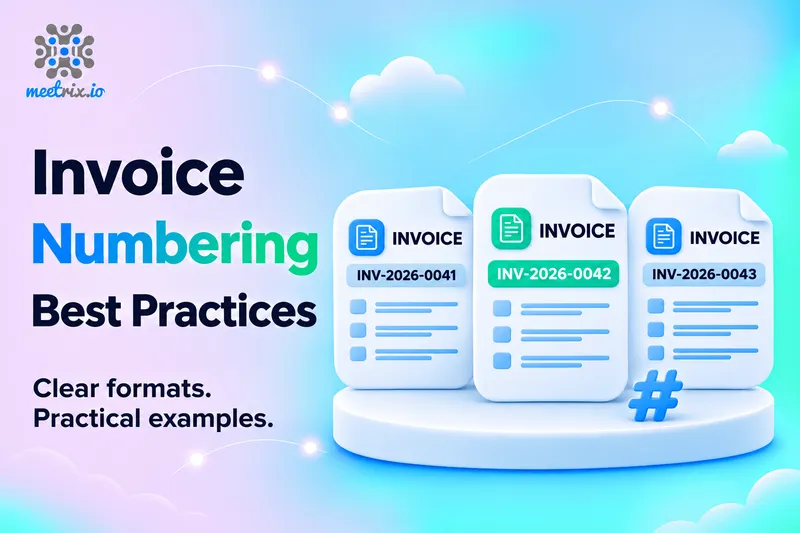
A good invoice numbering format is boring on purpose. It's usually just a short prefix, maybe the year, and a counter that only ever goes up, like INV-2026-0042. Every number is used exactly once, never reused, and anyone looking at it a year from now can instantly tell when it was issued. That's 90% of the battle.
The rest is the fine print that matters once you've sent a few hundred invoices: when to reset the counter, what to do with a cancelled invoice, how to keep your numbering going when you switch software, and what the tax rules actually say.
Below, we'll break down the rules, look at seven example formats (and when to use each), cover the common mistakes, and show how to set custom number formats in Invantra (the self-hosted invoicing tool we make).
Anatomy of a good invoice number
Invoice numbering best practices
Whatever pattern you choose, it should pass these five checks:
- UniqueNo two invoices should ever share a number, across every client and every year. This is the one rule with absolutely no exceptions.
- SequentialThe counter goes up by one each time within its series. Anyone checking your books should be able to see that nothing is missing.
- Never reusedA cancelled invoice keeps its number. If you give that number to a new invoice, you now have two documents claiming the same identity.
- SortablePad the counter with zeros (use 0042, not 42) and put the year before the month. This ensures your numbers sort chronologically in any spreadsheet or file list.
- Short enough to read out loudClients will quote this number in bank transfers and over the phone. INV-2026-0042 works perfectly. 2026-11-23-ACMECORP-WEBREDESIGN-PHASE2-INV-0001 does not.
Sequential invoice numbering: what the rules say
No law prescribes an exact pattern, but European VAT rules come close to describing one. Article 226(2) of the EU's VAT Directive asks for "a sequential number, based on one or more series, which uniquely identifies the invoice". HMRC's guidance for UK VAT invoices uses the same wording, allowing letters as well as digits, and separate series (like one per branch or per customer).
So, prefixes, years, and multiple series are all perfectly fine, as long as each number is unique and runs in sequence within its series. HMRC's own FAQ confirms you can even start your series at a number like 1135 rather than 1, as long as it runs consecutively from there.
While the legal text doesn't explicitly say "no gaps," it's what auditors look for in practice. A missing number invites the question: where did that invoice go? Outside the EU and UK, rules are usually looser, but these habits are still the safest bet. Always check with your accountant if you invoice across multiple countries.
Allowed by the rules
- Letters as well as digits
- Prefixes and years in the number
- Several series at once, such as one per branch or per customer
- Starting at a number like 1135 rather than 1
What auditors look for
- The same number on two invoices
- Gaps in a series with no explanation
Disclaimer
Invoice numbering format examples
Here are seven common patterns, along with when each one fits and when its counter should restart.
| Format | Example | Counter restarts | Good for |
|---|---|---|---|
| Plain sequence | INV-0042 | Never | Small businesses that want the simplest thing that works |
| Year and sequence | INV-2026-0042 | Each year | Most businesses: the year makes yearly resets safe and filing easy |
| Year, month, and sequence | INV-202611-07 | Each month | Higher volume, or when you reconcile month by month |
| Date and daily count | 20261123-01 | Each day | Many invoices a day, such as retail or events |
| Client code and sequence | ACME-0012 | Never, per client | A few long-running clients who like their own series |
| Project code and sequence | P214-03 | Never, per project | Agencies billing several invoices against one project |
| Branch or entity series | LON-2026-0015 | Each year, per branch | Several offices or companies invoicing separately |
Client and project series look tidy, but they require care: each one must still be unique across your entire business. So, ACME-0012 and a second client's 0012 have to stay clearly distinguishable by their prefixes. If you're unsure, start with year and sequence. It's the one format that rarely needs changing later.
How to number invoices for your business
Go with INV-2026-0001. Restart each January, and you'll always know which year an invoice belongs to.
Keep the invoice number simple (INV-2026-0001) and put the project code in a separate reference or project field. Mixing both into the number makes it long and fragile.
Add the month, INV-202611-0001, so each month's run is easy to check against the bank.
Use one series per entity, each with its own prefix, so the numbers never collide. HMRC explicitly permits multiple concurrent series.
Number estimates, credit notes, and payments too
Invoices aren't the only documents that need a series. Give each type its own prefix so nobody mistakes one for another:
EST-2026-0001
Credit notes
CN-2026-0001
Always reference the original invoice they correct.
Payments received
Give them their own running number, so a remittance can be traced to the exact payment record.
When an estimate becomes an invoice, carry the estimate number onto the invoice as a reference. It instantly answers the question, "Which quote was this?" without anyone digging through old emails.
Common invoice numbering mistakes
Deleting a cancelled invoice
Deleting leaves a gap with no explanation. Void it instead, so the number stays on record with a status that says what happened.
Reusing a number
Two documents with one number is the hardest mistake to untangle, especially once a client has paid against it.
Changing format mid-year
Switching in October splits a year across two series. Change at the start of a financial year if you can.
Numbering by hand
Two people working from one spreadsheet will eventually pick the same next number. Let software assign it.
Restarting at 1 when switching tools
A new tool starting at INV-0001 duplicates numbers you've already issued. Set the counter to carry on from your last invoice.
Dates without a counter
20261123 works until the second invoice that day. Always end with a counter.
Custom invoice number formats in Invantra
In Invantra, each document type (estimates, invoices) gets its own number format in Settings, written as a template. The documentation cites examples like INV-0001 or EST-202610-01 with a monthly reset. Here are the tokens you can use:
| Token | Becomes |
|---|---|
{YYYY} | The four-digit year of the issue date, e.g., 2026 |
{YY} | The two-digit year, e.g., 26 |
{MM} | The month, e.g., 11 |
{DD} | The day, e.g., 23 |
{seq} | The counter, e.g., 42 |
{seq:4} | The counter padded to 4 digits, e.g., 0042 |
So, INV-{YYYY}-{seq:4} gives you INV-2026-0042, and EST-{YYYY}{MM}-{seq:2} gives you EST-202611-07.
INV-{YYYY}-{seq:4}INV-2026-0042restarts each JanuaryEST-{YYYY}{MM}-{seq:2}EST-202611-07restarts each monthINV-{seq:4}INV-0042never restartsResets follow the format
You don't set a reset rule separately. The counter starts again whenever the fixed part of the number changes. INV-{seq} has no date in it, so it runs on forever. INV-{YYYY}-{seq:4} starts at 0001 each January, and a format with the month in it starts again each month. Each period keeps its own counter, so the numbers stay unique.
No duplicates, even when two people save at once
A number is assigned when a document is first saved, inside the same database transaction as the save. This means two people saving at the exact same moment can't get the same number. You can also type a number in by hand, which leaves the counter alone. And when a document goes back to draft for changes, it keeps its number.
Carry on from your old tool
The counters are editable in Settings, so after a move you can set the next number to follow your last one, and imported documents keep their original numbers.
Void, don't delete
From version 1.1.0, admins can delete an estimate or invoice, and Invantra never reuses a deleted number, but deleting still leaves a gap in the series. For a cancelled invoice, use Void: the document stays on record, clearly marked, and the series stays complete.
Void
- The document stays on record, clearly marked
- The number stays in the series
- The series stays complete for your accountant
Delete
- The document is gone for good
- The number is never reused, so the series has a gap
- Admins only, from version 1.1.0
Two smaller touches help with numbering day to day. Converting an approved estimate sets the invoice's reference to the estimate number, and the PDF saves with the document number as its file name, so you get INV-2026-0042.pdf rather than invoice (3).pdf. Invoices only reach a client after they're approved.
(Invantra runs on your own server, either from a ready-made AWS image or with Docker Compose. Be aware of what it doesn't do: it doesn't calculate tax, send email, or take card payments.)
Frequently Asked Questions
What is an invoice number?
A unique identifier given to each invoice, usually a prefix plus a counter such as INV-2026-0042, so you, your client and your accountant can all refer to exactly one document.
What is the best invoice numbering format?
For most businesses, a year followed by a sequence (INV-2026-0001) is the best balance of readability, sorting, and easy annual resets.
Do invoice numbers have to be sequential?
Legally, VAT rules require a 'sequential number based on one or more series.' Practically, this means no gaps, so if you cancel an invoice, you should void it rather than delete it.
Can an invoice number include letters?
Yes. HMRC and most EU tax authorities allow letters and digits in the prefix, as long as the sequence remains unique.
Should invoice numbers restart every year?
It's a common practice and perfectly legal. If your format includes the year (INV-2026-0001), restarting the counter at 0001 every January keeps things tidy and easy to file.
What number should my first invoice be?
Start at 0001 (or 1). If you're migrating from another system, start at the next number in your old sequence so you don't duplicate anything. HMRC also permits starting at a higher number like 1135 if you prefer.
What happens to the number if I cancel an invoice?
The number is retired but never reused. Mark the invoice as 'Void' so it stays on record with an explanation, leaving the sequence intact.
Set Your Invoice Numbering Once, Then Forget It
Launch Invantra on your own AWS account with custom number formats, an approval step and nightly backups set up. No per-user fees.
Start the 5-Day Free Trial