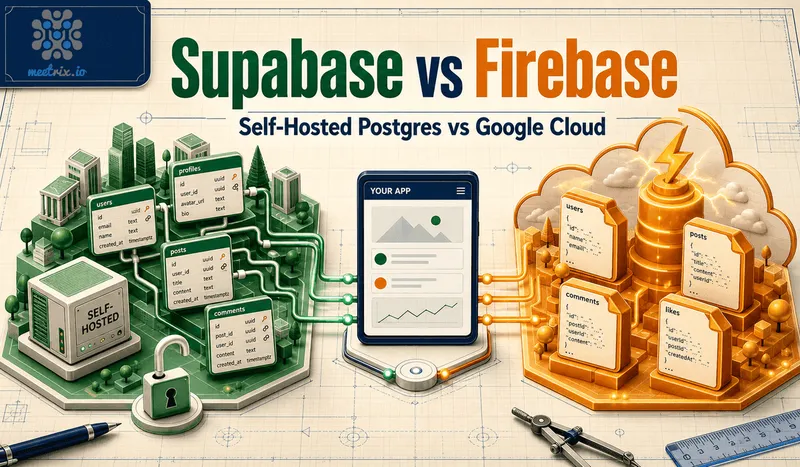
Supabase vs Firebase isn't really a feature-parity contest, both cover auth, storage, and a database well. It's an architecture decision: Supabase runs on real Postgres, full SQL, joins, relational integrity, that you can self-host on your own infrastructure. Firebase runs on Firestore, a proprietary NoSQL document store with no self-hosting path at all, ever. (If it's a document database you want, MongoDB is the one you can self-host; we've compared MongoDB Atlas pricing with running it on EC2.) That single difference decides more of this comparison than any pricing table. If you came here asking whether Supabase can be self-hosted on Google Cloud, skip ahead, that answer is up front.
Quick answer
Jump to a section
Can you self-host Supabase on Google Cloud?
Yes. Most people land here asking exactly that, so it goes first.
Supabase self-hosts as a Docker Compose stack, which makes a Compute Engine VM running Docker the boring, working answer. GKE is fine if you already run Kubernetes. Cloud Run is not, because the stack is a set of long-lived stateful services and Cloud Run wants one request-driven container.
Cloud SQL is where it gets awkward, and that is the version of the question most people actually mean. Supabase is not just Postgres. It is Postgres plus a set of roles and extensions the other services expect, and Cloud SQL permits only a fixed extension list and never hands you a real superuser. pgvector is on that list, so embeddings are fine. pg_graphql and pgjwt are not.
So run Postgres inside the Compose stack, on a Compute Engine VM, with your own snapshot schedule on the data disk. That is what most teams settle on and I would not fight it. Our Supabase on GCP guide covers that deployment end to end, and the GCP Marketplace listing puts the whole stack in your own project without the manual setup.
Supabase: Postgres with auth, storage, and realtime built in
Supabase's core is Apache-2.0 licensed, with individual components, GoTrue for auth, PostgREST for the instant REST API, Realtime, and Storage, released under MIT, Apache-2, or the PostgreSQL license depending on the piece. Underneath all of it is a genuine Postgres database, not a proprietary abstraction, so anything that works in Postgres (joins, foreign keys, extensions like pgvector for embeddings) works in Supabase. Cloud pricing runs Free at $0, Pro from $25/month, Team from $599/month, and custom Enterprise. Self-hosting the whole stack via Docker Compose costs nothing beyond your own server.
Key facts
- Apache-2.0 core, self-hostable via Docker Compose at no license cost
- Real Postgres database, full SQL, joins, and extensions like pgvector
- Auth (GoTrue), instant REST API (PostgREST), Storage, and Realtime bundled together
- Cloud pricing: Free, Pro at $25/month, Team at $599/month, custom Enterprise
Firebase: fast to start, fully managed, no self-hosting ever
Firebase is a proprietary Google Cloud product with no self-hosting option at any tier, by design. Spark, the free plan, includes 50,000 Firestore reads and 20,000 writes per day, plus 1GiB of storage. Blaze, the pay-as-you-go plan, charges $0.06 per 100,000 reads and $0.18 per 100,000 writes, no fixed monthly fee, but costs that scale directly with usage. Auth is free up to 50,000 monthly active users on both plans. The database underneath, Firestore, is a NoSQL document store, a genuinely different data model from a relational database, with its own query language and no native joins across collections.
Key facts
- Firestore: NoSQL document database, no SQL joins, different query model entirely
- Spark (free): 50,000 reads/day, 20,000 writes/day, 1GiB storage
- Blaze (pay-as-you-go): $0.06/100K reads, $0.18/100K writes
- No self-hosting option at any price, fully managed by Google only
Postgres vs Firestore: the real difference
This is the part most Supabase vs Firebase comparisons reduce to a feature checklist, and it deserves more than that. Firestore stores data as documents in collections, fast for simple reads and writes, but querying across relationships (a user's orders, an order's line items, each item's product) means either denormalizing your data upfront or making multiple round trips in application code. Supabase Postgres handles that with a single SQL join. If your app's data is genuinely relational, and most business applications are, that difference compounds as the schema grows, not just at launch.
Cost
Firebase's Blaze pricing scales with usage, which is generous at low volume and unpredictable at scale, a viral spike in reads shows up directly on the next invoice with no warning. Supabase Pro at $25/month bundles a fixed allocation of database, auth, storage, and Edge Function usage, more predictable for budgeting even before self-hosting enters the picture. Self-hosted Supabase removes the recurring fee entirely, you're paying for the server, not per-operation, which matters most for apps with high read/write volume that would rack up real money on Firebase's per-operation pricing.
What self-hosting Supabase actually gives up
Self-hosting via Docker Compose runs the same components Supabase Cloud runs, Postgres, GoTrue, PostgREST, Realtime, Storage, and Kong as the gateway, at no license cost. What you lose is real and worth stating plainly: managed backups, point-in-time recovery, database branching, and the multi-project Studio dashboard Cloud provides. Every upgrade becomes something your team schedules and tests, not something that happens automatically. This isn't a reason to avoid self-hosting, it's the honest tradeoff, free infrastructure in exchange for owning operational tasks a managed plan would otherwise handle.
Supabase vs Firebase: the facts
| Criterion | Supabase | Firebase |
|---|---|---|
| Database model | Postgres, relational, SQL | Firestore, NoSQL document store |
| License | Apache-2.0 (core) | Proprietary |
| Self-hostable | Yes, via Docker Compose | No, never |
| Free tier | Free plan, generous limits | Spark: 50K reads/day, 20K writes/day |
| Paid pricing | Pro $25/mo, Team $599/mo | Blaze: $0.06/100K reads, usage-based |
| Auth included | Yes, GoTrue | Yes, Firebase Auth |
| Joins across relations | Native SQL joins | Not native, denormalize or query client-side |
| Vendor lock-in risk | Low, standard Postgres underneath | Higher, Firestore's model is Google-specific |
Where each one falls short
Supabase
- Self-hosting means owning backups, point-in-time recovery, and upgrades yourself
- Smaller managed-service ecosystem than Google's around Firebase (push notifications, ML Kit, etc.)
- Relational schema design requires more upfront thought than Firestore's schema-less documents
Firebase
- No self-hosting option at any price, you're on Google's infrastructure permanently
- No native joins, relational queries mean denormalizing data or multiple round trips
- Usage-based pricing can spike unpredictably with traffic, no fixed ceiling
Supabase vs Firebase comes down to whether your data is relational and whether self-hosting matters to you, ever. If both answers are no, Firebase's speed to a working prototype is real and worth using. If either answer is yes, Supabase's Postgres foundation removes a migration you'd otherwise face later, when the NoSQL model stops fitting the app you actually built.
Our Supabase developer guide and self-hosting walkthrough cover the Docker Compose setup in full, and the GCP deployment guide covers that platform too, with the Supabase GCP Marketplace listing deploying the open-source Firebase alternative inside your own GCP project in minutes. If your project needs a database without any of Supabase's bundled services, our MongoDB developer guide covers the self-hosted NoSQL route directly.
Frequently Asked Questions
Can you self-host Supabase on Google Cloud?
Yes. Supabase self-hosts as a Docker Compose stack, so a Compute Engine VM running Docker is the straightforward path, and GKE works if you already run Kubernetes. Cloud Run does not fit, because the stack is long-lived stateful services rather than one request-driven container.
Can Supabase be self-hosted on Google Cloud SQL Postgres?
Only with real rework. Cloud SQL permits extensions from a fixed list, and ones Supabase relies on such as pg_graphql and pgjwt are absent. It also never grants a true superuser, so Supabase's bootstrap roles and migrations have to be rebuilt by hand.
Supabase vs Google Cloud: which am I actually choosing between?
Usually neither, as phrased. Google Cloud is where self-hosted Supabase runs, so they are not competitors. The real decision is Supabase Cloud's managed plan against Supabase in your own GCP project, which comes down to who owns backups and point-in-time recovery.
Supabase vs Firebase: what's the fundamental difference?
Supabase gives you a real Postgres database, full SQL, joins, relational integrity, extensions like pgvector. Firebase's Firestore is a NoSQL document store with a different query model entirely. If your data has real relationships, that architectural difference matters more than any feature checklist.
Is Supabase a genuine firebase alternative for production apps?
Yes. It bundles Postgres, Auth (GoTrue), instant REST and realtime APIs (PostgREST), file storage, and Edge Functions, covering the same ground Firebase covers, on top of a standard relational database instead of a proprietary NoSQL store.
How does Firebase pricing actually work?
Spark, the free tier, includes 50,000 Firestore reads and 20,000 writes per day plus 1GiB storage. Blaze, the pay-as-you-go tier, charges $0.06 per 100,000 reads and $0.18 per 100,000 writes, with no fixed monthly fee but costs that scale directly with usage.
Can I migrate from Firebase to Supabase Postgres later?
Technically yes, but it's real work, not a button. Firestore's NoSQL document structure has to be remodeled into relational tables, there's no automatic schema translation. Plan it as a data migration project, not a configuration change.
Launch Supabase on AWS in Minutes
Launch a pre-configured Supabase server on AWS, real Postgres with auth, storage, and realtime already wired up, no per-operation pricing.
Get Supabase on AWS Marketplace