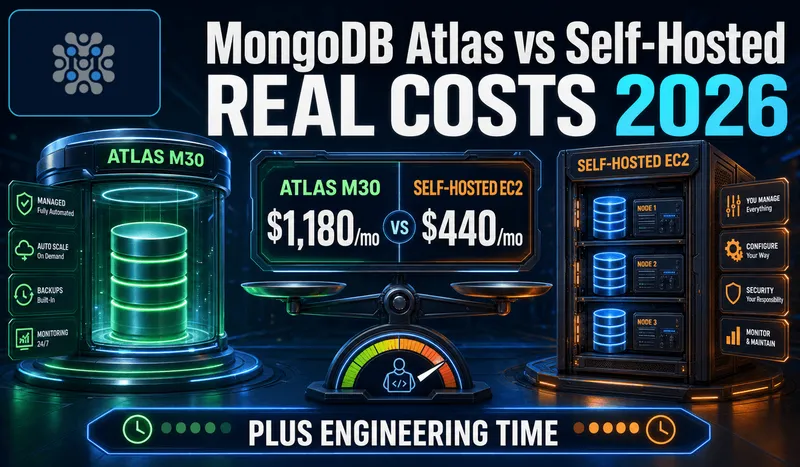
Most MongoDB Atlas vs self hosted comparisons stop at the infrastructure bill, and that's an incomplete answer. Self-hosted EC2 usually looks cheaper than an equivalent Atlas dedicated cluster, often by several times on compute alone, but that number leaves out the engineering time it takes to actually run MongoDB well: patching, backup verification, and failover testing that Atlas's price already has baked in. We deploy MongoDB with automated S3 backup on AWS, so here's the honest version, real 2026 pricing on both sides, including the cost most comparisons leave out.
Quick answer
Jump to a section
- MongoDB Atlas pricing in 2026
- AWS MongoDB pricing on EC2
- MongoDB Atlas cost, tier by tier
- The hidden cost most comparisons skip
- The cross-AZ data transfer cost nobody prices in
- Security and compliance: what Atlas includes by default
- The facts table
- Why we deploy MongoDB with S3 backup
- Where I'd start
MongoDB Atlas pricing in 2026: fully managed, billed per node
MongoDB Atlas is MongoDB's own fully managed database-as-a-service. M0 is free forever with tight resource limits, useful for a prototype, not production. Flex, which replaced the older Serverless and shared M2/M5 tiers in 2025, starts around $8/month and caps near $30/month for light, spiky workloads. Dedicated clusters start at M10, $0.08/hour per node (about $57/month each), and scale up through M20, M30, M40, and beyond to M700 for the largest deployments. Backups, data transfer, and several add-on features bill separately from the base cluster price, and Atlas retired its Serverless instance model entirely on January 22, 2026, migrating remaining workloads to Free, Flex, or Dedicated tiers.
The detail that trips up most budgets: the tier price on the Atlas pricing page is charged for each data-bearing node. MongoDB's billing docs say it plainly: "Atlas charges the cluster cost and data storage cost for each data-bearing node in your cluster." A default replica set has three, so an M30 listed at $0.54/hour is about $1,180 a month, not $394.
Is MongoDB Atlas open source?
No. Atlas is a proprietary managed service. The server it runs, MongoDB Community Server, has been under the Server Side Public License since 2018. That's source-available, not OSI open source, but it's free to self-host, which is what the rest of this comparison is about.
MongoDB Atlas pricing on AWS Marketplace
You can also buy Atlas through AWS Marketplace and have it billed on your AWS invoice, which helps if you're burning down an AWS commit. The tier rates are the same; what changes is who sends the bill.
Key facts
- M0 free tier, Flex tier from ~$8-30/month for light workloads
- Dedicated clusters from M10 ($0.08/hour per node, ~$175/month for 3 nodes) up through M700
- Fully managed: automated backups, patching, and scaling included
- Serverless tier retired January 22, 2026; workloads migrated to Free, Flex, or Dedicated
AWS MongoDB pricing: what self-hosting on EC2 costs
Self-hosting MongoDB on your own EC2 instances means paying AWS's standard compute and storage rates, with no MongoDB-specific management markup on top. The fair comparison is shape for shape. Atlas M30 is 8 GB of RAM and 2 vCPUs per node, which is an m6g.large; three of those cost about $170 a month on-demand in us-east-1, against roughly $1,180 for an M30. A 3-node replica set on r6g.xlarge instances (4 vCPU, 32GB RAM each) runs roughly $440/month in compute, and that's a much bigger machine than an M30: it has the RAM of an M50, which Atlas lists at about $4,380 a month for three nodes. Add EBS gp3 storage (roughly $120/month for 500GB across three nodes) and backup infrastructure, and the total is still well under the equivalent Atlas tier. What you take on in exchange is real: you're responsible for patching, replica set configuration, backup automation, and monitoring yourself, unless that's already handled by a pre-configured deployment.
Key facts
- M30-sized 3-node replica set (3 x m6g.large): about $170/month in EC2 compute vs Atlas M30's ~$1,180/month
- EBS gp3 storage for a 500GB x3-node setup: roughly $120/month additional
- No per-node management markup, you pay AWS's standard infrastructure rates
- Patching, HA configuration, and backup automation are your responsibility unless pre-configured
Which MongoDB AWS instance type to pick
MongoDB is happiest when its working set (the data and indexes you touch often) fits in RAM, so size by memory first. The memory-optimized r6g/r7g family is the usual choice for production, general-purpose m6g/m7g works for balanced loads, and burstable t4g belongs on dev boxes only, since it throttles under sustained load. MongoDB's production notes recommend XFS for the data volume, and gp3 EBS lets you buy IOPS separately from size.
MongoDB Atlas cost vs self-hosted, tier by tier
Here's the same comparison for the four tiers people actually price. Atlas figures are the published us-east-1 rates times three nodes; EC2 figures are three Graviton instances with the same RAM and vCPU, on-demand, plus gp3 storage equal to the Atlas default disk. Neither column includes backups or data transfer.
| Shape (per node) | MongoDB Atlas, 3 nodes | Self-hosted EC2, 3 nodes |
|---|---|---|
| 2 GB, 2 vCPU (M10) | $0.08/hr x 3, ~$175/mo | t4g.small x 3, ~$40/mo |
| 8 GB, 2 vCPU (M30) | $0.54/hr x 3, ~$1,180/mo | m6g.large x 3, ~$180/mo |
| 16 GB, 4 vCPU (M40) | $1.04/hr x 3, ~$2,280/mo | m6g.xlarge x 3, ~$355/mo |
| 32 GB, 8 vCPU (M50) | $2.00/hr x 3, ~$4,380/mo | m6g.2xlarge x 3, ~$715/mo |
Prices change, so check the Atlas calculator and EC2 on-demand pricing for your region before you commit. The gap looks enormous. It isn't the whole story, and the rest of this article is about why.
These figures are illustrative, drawn from public infrastructure pricing and TCO analyses as of 2026, actual costs shift with region, reserved-instance discounts, and configuration. At small scale, an Atlas M10 replica set runs around $175/month against about $40 for three t4g.small instances, though M10 is often used for dev/test rather than production HA. At mid-scale, a 3-node Atlas M30 replica set runs roughly $1,180/month before storage and transfer, against roughly $170/month in EC2 compute for the same RAM and vCPU, plus storage. At the M50 tier and above, the gap widens further: Atlas M50 runs in the range of $4,380/month for three nodes, while an M50-shaped self-hosted cluster is around $715/month on-demand, and less again on reserved instances. The infrastructure gap is real and grows with scale, which is exactly why the next two sections matter.
One nuance worth being precise about: EC2 Reserved Instances currently discount up to 72% off on-demand rates for 3-year terms, and that's where a lot of the self-hosted savings above come from. But that discount applies to compute hours only. EBS storage, provisioned IOPS, backup storage, and data transfer keep billing at full on-demand rates no matter how long you've committed to your instances. A back-of-envelope self-hosted estimate that only discounts the EC2 line item and forgets the rest overstates the savings.
The cross-AZ data transfer cost nobody prices in
A production MongoDB replica set needs nodes spread across multiple Availability Zones for real fault tolerance, and that's where a specific, easy-to-miss self-hosted cost shows up. AWS charges $0.01 per GB, each direction, for traffic crossing Availability Zones within the same region. Replica set traffic between a primary in one AZ and secondaries in others runs up that meter continuously, and it's not a one-time fee, it scales with your write volume and oplog size for as long as the cluster runs. This catches people off guard specifically because AWS's own managed RDS Multi-AZ deployments don't charge for that same synchronous replication traffic, self-managed EC2 does. It's rarely the biggest line item on the bill, but at meaningful write throughput it's a real, recurring cost that a compute-only estimate leaves out entirely.
MongoDB Atlas cross-region replication
Going multi-region multiplies both sides. On Atlas, each extra region adds its nodes at that region's rate, plus inter-region transfer, and the price shown when you create the cluster only covers the preferred region. Self-hosted, you pay AWS's inter-region transfer rate (higher than cross-AZ) on all replication traffic. Either way, price a second region separately, not as a percentage on top.
Security and compliance: what Atlas includes by default
Atlas ships with a compliance and security baseline that would otherwise be real configuration work: AES-256 encryption at rest by default on every cluster and snapshot, mandatory TLS on all database connections, and private connectivity via AWS PrivateLink, Atlas was among the first PrivateLink-validated partners. On the compliance side, Atlas maintains SOC 2 Type II, ISO/IEC 27001, and PCI DSS attestations, and has passed a third-party HIPAA examination, relevant if you're building in a regulated space and would otherwise need to produce that evidence yourself. None of that is unavailable on self-hosted EC2, EBS volume encryption, security groups, your own TLS certificates, and VPC-level network isolation all exist, but you're the one configuring, documenting, and periodically re-auditing it, not checking a box that's already been attested to by a third party.
The hidden cost most comparisons skip: your time
A self-hosted EC2 bill that's a third of Atlas's price isn't the full cost of ownership, and pretending otherwise is how a lot of "self-hosting is obviously cheaper" arguments fall apart in practice. Running MongoDB well yourself means patching the OS and database engine, configuring and testing replica set failover, verifying backups actually restore (not just that they ran), and monitoring for the kind of issues Atlas surfaces automatically. Public cost analyses commonly put that ongoing operational time at roughly $400/month or more in engineer hours, even for a modest deployment, before counting the setup time to get there in the first place. That doesn't make self-hosting a bad choice, it makes "self-hosted is 3x cheaper" an incomplete sentence unless you've actually priced your own team's time into it.
MongoDB Atlas vs self hosting: the facts
| Criterion | MongoDB Atlas | Self-Hosted on EC2 |
|---|---|---|
| Entry-level pricing | M0 free, Flex ~$8-30/mo | Single small instance, often under $30/mo |
| Mid-tier (M30-equivalent) | ~$1,180/mo (3-node, before storage/transfer) | ~$170/mo compute (3 x m6g.large) + storage |
| Large-tier (M50-equivalent) | ~$4,380/mo (3-node) | ~$715/mo on-demand (3 x m6g.2xlarge), less on reserved |
| Backups | Automated, billed separately | Your responsibility unless pre-configured |
| Patching and upgrades | Fully managed | Your responsibility |
| Ongoing operational time | Minimal, included in price | Real, often ~$400/mo+ in engineer time |
| Data transfer fees | Billed separately from base cluster | Standard AWS rates, plus $0.01/GB cross-AZ replica traffic |
| Encryption at rest | AES-256 by default, every cluster | EBS encryption, configured by you |
| Compliance attestations | SOC 2 Type II, ISO 27001, PCI DSS, HIPAA-examined | You own the audit and evidence |
| Private connectivity | AWS PrivateLink included | VPC/security groups, configured by you |
| Reserved-instance savings apply to | N/A, usage-based pricing | Compute only, not storage/IOPS/transfer |
Why we deploy MongoDB with S3 backup
Most teams that come to us don't want either extreme, hand-rolling MongoDB from a bare EC2 instance, or paying Atlas's per-node premium for management they could largely handle themselves with the right setup. That's the gap our MongoDB AMI with automated S3 backup fills: self-hosted infrastructure pricing, with backup automation already configured instead of built from scratch. It doesn't replace every Atlas feature, but it removes a real chunk of the operational time that makes "self-hosted is cheaper" only half-true on its own.
Our MongoDB developer guide covers the full setup (it's the same AMI, configured step by step), and our MongoDB AWS backup guide covers the automated S3 backup configuration specifically. If you're evaluating self-hosted databases more broadly, our Supabase developer guide and Supabase self-hosting guide cover a Postgres-based alternative worth comparing against a document database like MongoDB for the right workload. If you're weighing managed backends more generally, Supabase vs Firebase runs the same managed-or-self-hosted question for app backends, and our list of self-hosted software on AWS shows what else teams move off SaaS once the bill gets big.
Where I'd start
Small workload, don't want to think about infrastructure at all: Atlas's free or Flex tier is genuinely fine, and worth the premium once you're production-serious about not managing servers. Mid-to-large scale, comfortable owning operations, or already running other infrastructure on AWS: self-hosted EC2 saves real money, especially with a pre-configured AMI removing most of the backup and setup burden. The wrong move is comparing Atlas's sticker price to a self-hosted EC2 bill without pricing in the engineering time either path actually requires.
Frequently Asked Questions
MongoDB Atlas vs self hosted: which is actually cheaper?
Self-hosted EC2 wins on infrastructure price, often by several times at the same RAM and vCPU. But that ignores engineer time: patching, backup testing and failover work commonly cost several hundred dollars a month that Atlas's price already covers. A pre-configured AMI closes much of that gap.
What does MongoDB Atlas pricing actually look like in 2026?
M0 is free with tight limits. Flex runs $8 to $30 a month for light workloads. Dedicated clusters start at M10, $0.08/hour per node, so about $175 a month for a 3-node replica set, and scale up to M700. Backup, data transfer and add-ons are billed separately.
What's a realistic self hosted mongodb aws cost at small to mid scale?
A 3-node replica set on m6g.large instances (2 vCPU, 8 GB RAM each, the same shape as Atlas M30) runs about $170/month in us-east-1 on-demand compute, plus EBS storage and backups. Atlas M30 for the same three nodes lists at about $1,180/month, before you price in your engineers' time.
Is MongoDB Atlas open source?
No. Atlas is MongoDB's proprietary managed service. The database it runs, MongoDB Community Server, is source-available under the Server Side Public License (SSPL), which the Open Source Initiative does not approve. You can self-host Community Server for free; you can't self-host Atlas.
Which MongoDB AWS instance type should I use?
Size RAM to hold your working set (hot data plus indexes). Memory-optimized r-family instances suit most production replica sets, general-purpose m-family works for balanced loads, and burstable t-family only for dev or tiny workloads. Pair them with gp3 EBS and XFS.
Is there a good MongoDB Atlas alternative that isn't just running MongoDB yourself from scratch?
Yes. Our MongoDB AMI with S3 backup pre-configures automated backups and a production-ready setup on your own EC2 instance, so you get self-hosted pricing without building the backup and operations tooling from zero.
Did MongoDB Atlas Serverless get discontinued?
Yes. Atlas Serverless instances were retired on January 22, 2026, with existing workloads migrated to Free, Flex, or Dedicated clusters. If you were pricing based on the old serverless model, that number is no longer current.
What costs do people forget when comparing MongoDB Atlas vs self hosted?
On the Atlas side, data transfer and backup fees billed separately from the base cluster price. On the self-hosted side, the ongoing engineering time for patching, monitoring, backup verification, and failover testing, easily several hundred dollars a month in labor even when the EC2 bill looks small.
Does self-hosted MongoDB have a cross-AZ data transfer cost like Atlas?
Yes, and it's easy to miss. A production replica set needs nodes in multiple Availability Zones, and AWS charges $0.01 per GB, each direction, for that cross-AZ traffic. Unlike RDS Multi-AZ, which doesn't charge for its own replication traffic, self-managed EC2 does, and it scales with write volume.
Does self-hosted MongoDB on EC2 include the same compliance certifications as Atlas?
No, not automatically. Atlas ships with SOC 2 Type II, ISO 27001, and PCI DSS attestations plus a completed HIPAA examination out of the box. Self-hosted EC2 can meet the same technical bar, encryption, TLS, network isolation, but you're responsible for configuring it and producing your own audit evidence.
Launch MongoDB with S3 Backup on AWS
Launch a pre-configured MongoDB server on AWS with automated S3 backup already set up, self-hosted infrastructure pricing without building the operations tooling from scratch.
Get MongoDB on AWS Marketplace