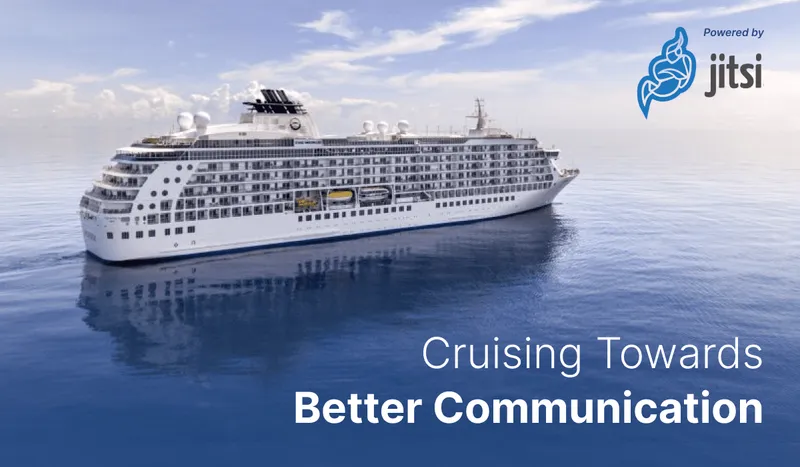
The largest residential ship in the market deploys Meetrix to improve Real-Time Communication on a unified platform and boost collaboration between members of staff on and off-board.
Introduction
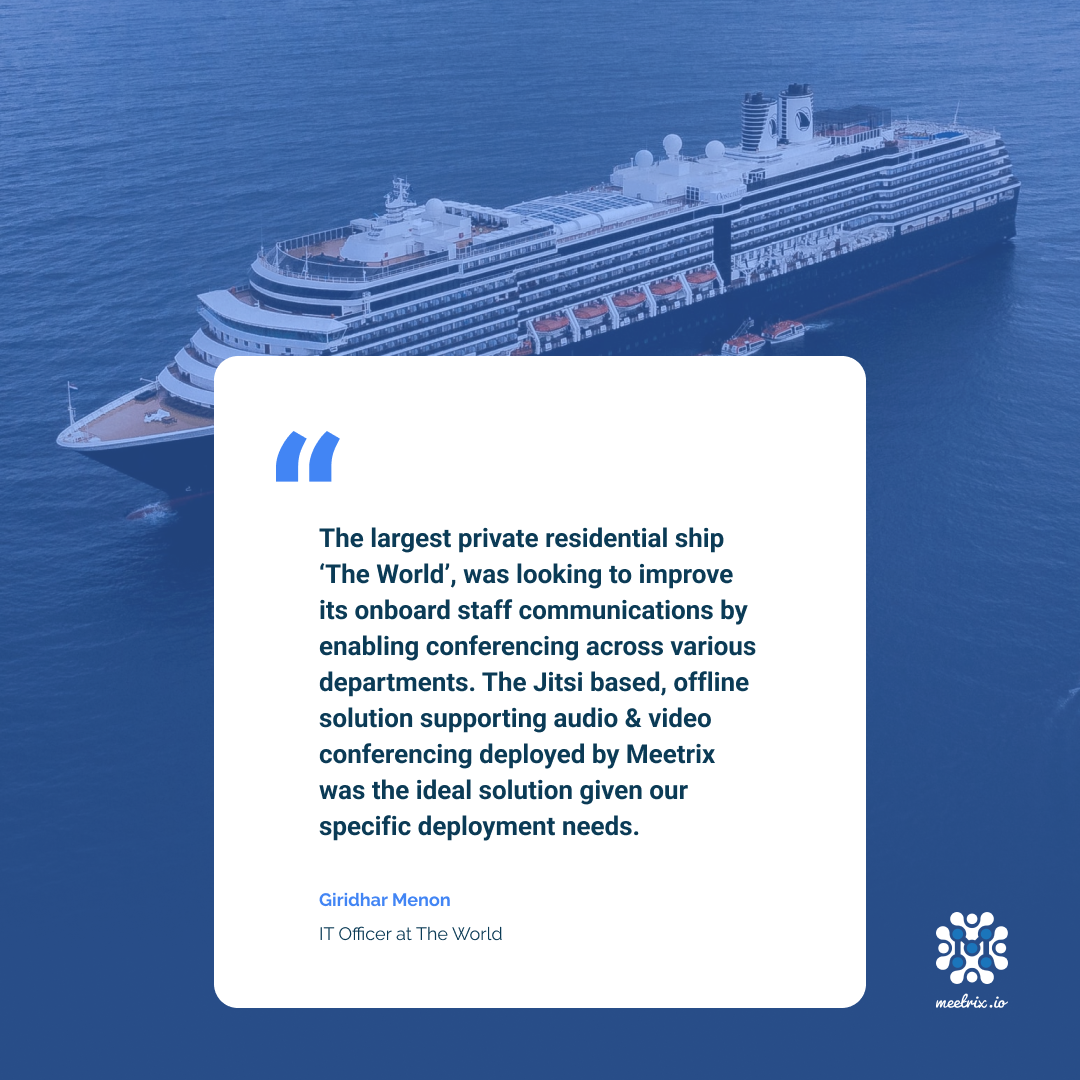
The World CC is a one-of-its-kind ship built to carry permanent residents. Its route is unique as it doesn’t have an itinerary and depends on the location picked by the residents. The team at The World CC reached out to Meetrix to tackle a number of issues, with a specific focus on facilitating video conferencing between members of the staff.
This project comprised three phases: the first of which focused on the non-auto-scaling of the infrastructure of Jitsi Meet followed by a second phase that focused on the reconfiguration of Jitsi after an erroneous update to the client’s Operating System. During the third and final phase, Meetrix was able to provide them with an updated version of Jitsi and help renew the SSL certificate of the video conferencing platform. This case study briefly reviews how The World CC’s need for effective communication was backed by Meetrix with problems related to the open-source video conferencing platform, Jitsi Meet.
The World CC was launched over two decades ago and is considered a pioneer in ensuring the best services to its clients. Their focus on client autonomy is what makes their need for a solid communication platform quintessential to their growth as a company. The World CC worked with Meetrix to enhance existing features within the platform and customize certain areas to best fit the needs of clients. Jitsi’s array of in-built features and easy-to-use interface allows it to be an ideal candidate for use across the grid, making it one of the most compatible communication platforms to work with.
How we kept the crew connected
The World CC had three key issues that required solutions, one of which was related to infrastructure and the other two in relation to the use of Jitsi by clients. The project was valued at around $1500 USD, with post-integration technical support provided. Negotiations first saw members of both teams meeting to analyze The World CC’s requirements and Jitsi Meet was able to make the following changes by tapping into its core features:
Non-Auto Scaling Infrastructure up to 20 concurrent users
In the first phase of the project, The World CC was able to adapt Jitsi Meet as its primary video conferencing platform for its reliability, security, and ability to function without the need for auto-scaling. The infrastructure of Jitsi Meet was able to provide up to 20 concurrent users with a seamless communication experience onboard the ship. The friendly interface of Jitsi Meet makes it an ideal platform for communication, especially for users who may be new to using video conferencing.
Twenty users is well inside what a single, fixed-size Jitsi server handles. Auto-scaling only earns its keep when attendance swings a lot, which is the case our guide to auto-scaling Jitsi videobridges covers.
Reconfiguration of Jitsi Meet
As a result of an erroneous Operating System (OS) upgrade made by the Client, Jitsi required reconfiguration. The process of the second phase involved distinguishing issues with compatibility, streamlining dependencies, and optimizing the setup of Jitsi Meet, such that it aligns with the updated OS. The World CC was able to maintain a stable communication platform once Jitsi Meet was reconfigured, reducing possible disruptions for users. The video conferencing platform was able to remain operational for users on board.
It's an easy way to break a Jitsi server that was working fine: the OS moves underneath it and the packages don't follow. If you're rebuilding one from scratch, our Jitsi Meet install guide for Ubuntu covers Ubuntu 22.04, 24.04 and 26.04, and the official Jitsi quick install has the package details.
Jitsi Version Upgrade
Lastly, a version upgrade of Jitsi was proposed as a solution to The World CC upon request, in order to access new features and improvements after bug fixes. These upgrades were necessary as they enhanced the overall performance and user experience of Jitsi Meet. Additionally, the upgrade allowed better compatibility with newer technologies and more recent protocols. The security patches in the upgrade were able to protect against vulnerabilities and ensure a safe communication environment for The World CC's users. Meetrix was also able to aid The World CC with SSL certificate renewal. This helped in ensuring continued security and reliability. Our walkthrough of Jitsi SSL certificate renewal explains how to keep that from lapsing again.
Conclusion
Meetrix was able to provide The World CC with efficient solutions, ensuring their specific needs were met in a timely manner. All three phases of the project were successfully implemented and established Meetrix’s mark as an excellent service provider.
The project with The World CC shows the potential and high scope of Meetrix. Its varied uses and dynamic features allow it to be useful in a multitude of areas. The components of Jitsi Meet that were introduced to The World CC have aided in its growth and added to its productivity such that the systems are still in use today.
Meetrix’s involvement with The World CC has ensured the ship and its residents a highly secure and effective communication platform for everyday use. As Jitsi Meet grows, so do the benefits of using it; Jitsi Meet is constantly striving to develop easier and more efficient features to help create lasting and impactful networks across the globe, to clients on land and at sea.
For two more Jitsi projects from the same period, see how we set up multi-region shards and Octo for Huddle XR and how we fixed Orga-Support's Jitsi bugs on an on-demand basis.
Frequently Asked Questions
What is the best way for crew to communicate on a cruise ship?
For The World CC, it was a self-hosted Jitsi Meet server: one video platform for staff on board and on shore, running on infrastructure the ship controls instead of a per-seat SaaS account.
How many users did the ship's Jitsi Meet setup support?
Up to 20 concurrent users, on a fixed-size, non-auto-scaling server. For a crew of that size, auto-scaling would have added cost and moving parts without any benefit.
Why did Jitsi Meet need reconfiguring?
An operating system upgrade on the client's side broke Jitsi's dependencies. Meetrix sorted out the compatibility issues and re-tuned the setup for the new OS so the platform stayed up for people on board.
What did the project cost?
Around $1,500 USD across all three phases, including post-integration technical support.
Why keep Jitsi Meet upgraded on a ship?
Security patches and compatibility. The final phase moved The World CC to a newer Jitsi release and renewed its SSL certificate, which closes known vulnerabilities and keeps browsers from refusing the connection.