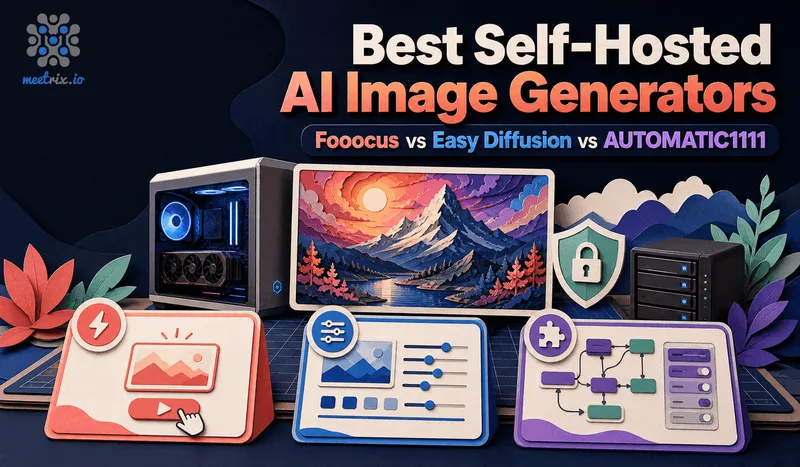
We package Fooocus as an AWS AMI with a hosted API, so weigh that against everything below. The best self hosted AI image generator depends on what you're optimizing for: fewest clicks to a good result, deepest customization, or the simplest possible install. Fooocus, AUTOMATIC1111 and Easy Diffusion are the three beginner-to-intermediate self hosted Stable Diffusion UIs people compare most, and two of them have quietly stopped adding new models.
If you're specifically weighing Fooocus against AUTOMATIC1111 or the node-based ComfyUI, our Fooocus vs AUTOMATIC1111 vs ComfyUI comparison covers that three-way choice in more depth.
Quick answer
Jump to a section
How to choose a self hosted AI image generator
Three questions cover most of it:
- Do you want to tweak parameters, or just type a prompt? AUTOMATIC1111 exposes everything, samplers, CFG scale, step count. Fooocus hides most of that and optimizes it for you automatically.
- Do you need an API for automation, or just a UI for yourself? Fooocus is the one we've packaged with a working API, useful if you want to generate images programmatically rather than clicking through a browser each time.
- Are you running this locally or on a cloud GPU? All three work either way, but if your own machine doesn't have the VRAM, a stable diffusion cloud deployment on a GPU instance is the realistic path, and that's where a ready-made AMI saves the most setup time. On a new AWS account, request a GPU quota first; it starts at zero (our vCPU quota guide shows how).
- Do you need the newest models? If Flux is on your list, that settles it: of these three, only Easy Diffusion runs it.
1. Fooocus: prompt-only simplicity, API included
Fooocus is GPLv3 licensed and built on a mix of AUTOMATIC1111 and ComfyUI's codebases, but the interface strips nearly all of that complexity away. The design goal, in the project's own words, is manual tweaking not needed, focus on the prompts and images, with the number of clicks between opening the app and generating a first image kept under three. We package it as an AWS AMI with a hosted API included, so it's also the one of the three built for automation, not just interactive browser use.
The catch: Fooocus is now in limited long-term support. The last release, v2.5.5, came out in August 2024, and the README says bug fixes only, with no plans to move to newer model architectures. It is an SDXL tool and will stay one. For Flux, the Fooocus team itself points people to Forge or ComfyUI.
Key features
- Prompt-only workflow, automatic optimization of the parameters AUTOMATIC1111 exposes manually
- GPLv3 licensed, built on AUTOMATIC1111 and ComfyUI foundations
- Hosted API included in the Meetrix AMI, for automated or programmatic generation
- Bug fixes only since v2.5.5, and SDXL only, no Flux
2. AUTOMATIC1111: the most powerful, and the most stalled
AUTOMATIC1111's Stable Diffusion WebUI is AGPL-3.0 licensed and, by GitHub star count (over 165,000), the most popular Stable Diffusion interface ever built. It exposes every parameter, samplers, CFG scale, step count, and has the largest extension ecosystem of any tool on this list, built up over years as the default choice for tutorials and guides. The honest problem: its last major release shipped in mid-2024, with only a minor 1.10.1 update in February 2025, and through 2026 the project has seen maintenance patches only, no new-architecture support. It can't run Flux, the model family much of the community moved to after SDXL.
Key features
- Every Stable Diffusion parameter exposed and adjustable
- The largest extension and plugin ecosystem of any Stable Diffusion UI
- The most tutorial and community documentation coverage anywhere
- No major release since mid-2024, no support for newer model architectures like Flux.1
3. Easy Diffusion: the simplest install, and the only one here that runs Flux
Easy Diffusion's whole pitch is the install experience: on Windows you download one installer and run it, on Linux and Mac you extract a folder and run ./start.sh. There's no separate Python environment or dependency wrangling. The interface is deliberately clutter-free, aimed at someone who has never run a command-line AI tool before.
The surprise is that it's the one still moving. Its v4 engine added Flux 1 and 2 along with several other newer model families and quantized models, while the other two tools on this list have stopped adding architectures. The README asks for 8 GB of system RAM and 25 GB of disk, supports NVIDIA and AMD cards from 2 GB of VRAM, and falls back to CPU if you have no GPU at all (slowly).
One correction to a common claim: Easy Diffusion is not plain MIT. Its license is MIT-style but adds use-based restrictions carried over from the CreativeML Open RAIL-M license, so check it if your use case is sensitive.
Key features
- One-click install with no separate environment setup
- Runs Flux 1 and 2 and other newer models on the v4 engine
- Clutter-free UI aimed specifically at non-technical users
- Runs on your own PC without cloud GPU costs, if your hardware supports it
- Smaller extension ecosystem than AUTOMATIC1111, by design
The maintenance gap nobody mentions
Most "best AI image generator" roundups treat AUTOMATIC1111 and Fooocus as safe defaults because of their star counts and tutorial coverage. That reputation is earned. But popularity and development pace are different things, and in 2026 both of them are effectively frozen: AUTOMATIC1111's last release was v1.10.1 in February 2025, and Fooocus has been in bug-fix-only support since v2.5.5 in August 2024. Neither runs Flux.
That isn't automatically a problem. A frozen tool doesn't break your workflow with surprise changes, and SDXL is still a good model. But if you want to follow new model releases, pick Easy Diffusion from this list, or look at ComfyUI or Forge, which is where most new-model support lands first.
Fooocus vs AUTOMATIC1111 vs Easy Diffusion: feature comparison
| Feature | Fooocus | AUTOMATIC1111 | Easy Diffusion |
|---|---|---|---|
| License | GPLv3 | AGPL-3.0 | MIT-style with use-based restrictions |
| Interface style | Prompt-only, automated tuning | Full manual parameter control | Simple, beginner-focused |
| Extension ecosystem | Small, growing | Largest of any Stable Diffusion UI | Small, by design |
| Hosted API available | Yes, included in our AMI | Via extensions, not built in | Not a primary feature |
| Active development | Bug fixes only (last release v2.5.5, Aug 2024) | Maintenance only (last release v1.10.1, Feb 2025) | Yes, v4 engine |
| Newer model support (e.g. Flux) | No, SDXL only | Not supported | Yes, Flux 1 and 2 |
| Install complexity | Low, under 3 clicks to first image | Moderate, more configuration options to learn | Lowest, true 1-click install |
Why we run Fooocus with a hosted API
Most teams that come to us wanting Stable Diffusion aren't trying to become power users of every sampler setting, they want good images generated reliably, often as part of an automated pipeline rather than a person clicking through a browser each time. Fooocus's prompt-only design already removes the tuning most people don't want to learn, and packaging it with a working API meant we could hand clients something that plugs into their own product instead of just a personal desktop app. Its bug-fix-only status actually suits an API server: the interface and endpoints don't shift under you. If a client needs Flux, though, Fooocus isn't the right base, and we'd say so.
Our Fooocus developer guide covers the full setup, and AWS and GCP installation guides cover both cloud platforms. Our Fooocus API configuration guide is the one to read if automation, not a browser UI, is the actual goal.
Where I'd start
Never touched Stable Diffusion before, or want Flux on your own PC: Easy Diffusion. Want good SDXL images with the least effort, or need an API for automation: Fooocus. Need a specific extension from the largest ecosystem available: AUTOMATIC1111, knowing it isn't getting new model support.
All three are free to run and modify. Fooocus and AUTOMATIC1111 are open source in the strict sense; Easy Diffusion adds use restrictions to its license. For most people, though, the real decision isn't licensing. It's how much friction you'll trade for how much control, and whether you care about models newer than SDXL.
Frequently Asked Questions
What is the best self hosted AI image generator in 2026?
Easy Diffusion if you want the newest models, since it is the only one of the three that runs Flux. Fooocus if you want good SDXL images from a prompt with no tuning, plus an API. AUTOMATIC1111 only if you need one of its extensions.
Fooocus vs AUTOMATIC1111: what's the real difference?
AUTOMATIC1111 exposes every Stable Diffusion setting and has the biggest extension library. Fooocus hides those settings and tunes them for you. Both are now in maintenance mode and neither runs Flux. Our separate Fooocus vs AUTOMATIC1111 vs ComfyUI comparison goes deeper.
Easy Diffusion vs AUTOMATIC1111: which should I pick?
Easy Diffusion for most people in 2026. It installs in one step, is still adding models (Flux 1 and 2 on its v4 engine), and runs on GPUs with as little as 2 GB. AUTOMATIC1111 only wins if you depend on a specific extension.
Is Fooocus good in 2026?
For SDXL images from a plain prompt, yes. It still produces some of the best results per click of any SDXL front end. But it is in bug-fix-only support and won't run Flux, so it is a stable tool, not a growing one.
Easy Diffusion vs Fooocus: which is easier for a beginner?
Easy Diffusion is easier to install: download, run, done, and it even falls back to CPU. Fooocus is easier to get good images from once it's running, because it picks the settings for you.
Is there a good stable diffusion cloud option instead of running it locally?
Yes. All three run on a cloud GPU instance, which helps if your laptop lacks the VRAM. We package Fooocus as a ready-to-launch AWS AMI with its API included, specifically for that use case.
Is AUTOMATIC1111 still worth using in 2026?
For its extension ecosystem and tutorial coverage, yes. For current models, no. Its last release was v1.10.1 in February 2025, and it doesn't support newer architectures like Flux.
Which of these three has the fewest license restrictions?
Fooocus (GPLv3) and AUTOMATIC1111 (AGPL-3.0) are standard open source licenses. Easy Diffusion uses MIT-style terms plus use-based restrictions taken from the CreativeML Open RAIL-M license, so it is not open source in the strict sense.
Launch Fooocus with a Hosted API on AWS
Launch a pre-configured Fooocus server on AWS with the API already set up, ready to generate images without tuning parameters or managing GPU drivers yourself.
Get Fooocus 2.0 on AWS Marketplace