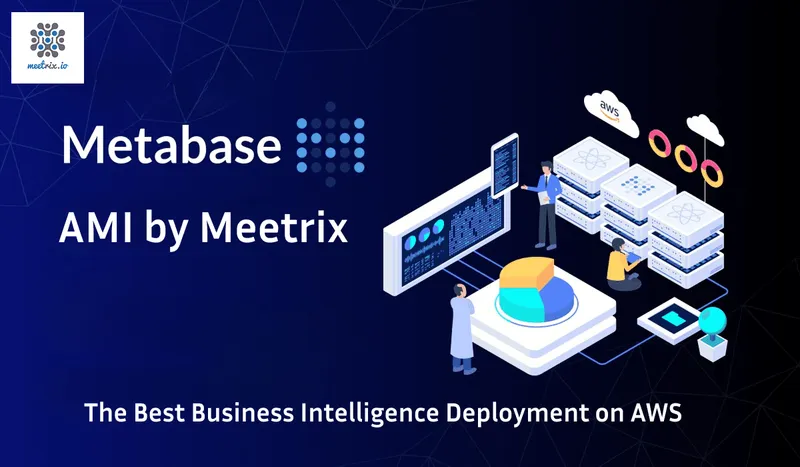
Metabase is the BI tool people pick when they want the sales team building its own charts without filing a ticket for every one. It's open source, the query builder genuinely works for people who don't write SQL, and the self-hosted edition has no per-seat fee. Getting it running on AWS properly is the annoying part: a JVM, a PostgreSQL application database, a reverse proxy, a certificate, and a backup plan that someone actually tests.
Meetrix's Metabase AMI does that wiring for you. This page covers what the listing actually installs, what it costs by the hour, how it differs from the other Metabase listings on AWS Marketplace, and the security settings worth checking before you point it at a production database. If you'd rather install everything by hand, our Metabase on AWS install guide walks through that route instead.
What You Get with Metabase on AWS from Meetrix
The listing is delivered as a CloudFormation template, not a bare AMI, so one launch creates the EC2 instance, the S3 bucket for backups and the IAM role that lets the instance write to it. As of October 2026 it ships Metabase 0.60.4 on Ubuntu 24.04.
- Metabase with PostgreSQL as its application database, not the H2 file Metabase falls back to by default. H2 is fine for a demo and a liability for anything you'd miss.
- Scheduled PostgreSQL backups to an S3 bucket you name at launch.
- HTTPS through Let's Encrypt once your Route 53 record points at the instance.
- Nothing else. No LAMP stack, no Webmin, no bundled MySQL. Metabase connects to whatever you already run: PostgreSQL, MySQL, Redshift, BigQuery, Snowflake, Athena and the rest of the 20+ supported data sources.
- Support from Meetrix engineers at support@meetrix.io, with a reply inside 12 hours.
The launch itself takes about ten minutes: pick a t3.medium, name the S3 bucket, add your domain, then finish Metabase's own setup wizard in the browser.
What It Costs per Hour
Metabase Open Source has no license fee. The Marketplace listing charges a software fee on top of EC2, and you can cancel at any time. There's no free trial on the listing at the moment and no refunds.
| Instance | Meetrix software fee | Good for |
|---|---|---|
| m7a.medium | $0.048/hour | Trying it out, a handful of users |
| t3.medium (recommended) | $0.104/hour | Small teams, light dashboards |
| t3.large, m7a.large, c6a.xlarge | $0.104/hour | Dozens of concurrent viewers, heavier queries |
Add the EC2 rate and a t3.medium in us-east-1 lands at roughly $0.15 an hour, about $106 a month left on around the clock. For comparison, Metabase's own Starter plan is $100 a month for the first five users and $6 for each one after that, and Pro is $575 a month for ten. If your team is small and nobody wants to own a server, Starter is the honest answer. Once you're past fifteen or twenty people, self-hosting pulls ahead quickly.
Metabase AWS Marketplace Listings Compared
Search the Marketplace for Metabase and you'll find around half a dozen listings. They fall into four groups, and the differences matter more than the logos suggest.
| Type of listing | Example | What you get | Watch out for |
|---|---|---|---|
| Metabase, Inc. | Sold by Metabase | Metabase's commercial plans, billed through AWS | Custom pricing, aimed at Pro and Enterprise buyers |
| Plain OS image with Metabase installed | ATH Infosystems, Hanwei (CentOS Stream 9) | Metabase on a base OS, sometimes with a support plan | Check which application database it uses and whether backups are set up at all |
| Free bundled stack | Eternal (Metabase + MySQL) | No software fee, MySQL preinstalled on the same box | Older OS release, and the bundled database is one more thing you patch |
| Packaged deployment | Meetrix | CloudFormation stack with PostgreSQL, SSL and S3 backups | Hourly software fee, no trial right now |
My take: if all you want is to click around Metabase for an afternoon, a free listing is fine. For anything people will depend on, the backup question decides it. A Metabase instance holds months of saved questions, dashboards and permissions, and it's very easy to lose all of that with one terminated instance if the application database lives on the same disk with no copy anywhere else.
Comparing Metabase against other BI tools rather than other listings? Metabase vs Redash vs Superset covers the trade-offs, and our guide to choosing a BI tool starts one step further back.
Secure Metabase on AWS: What to Lock Down
Metabase holds credentials for every database it connects to, so the instance deserves the same care as the databases themselves. Here's the checklist I'd run before a real launch:
- HTTPS only. The stack sets up Let's Encrypt. Don't publish port 3000 (Metabase's own HTTP port) in the security group.
- SSH from your IP only. Set the SSH source range at launch instead of leaving it open to 0.0.0.0/0.
- Read-only database users. Create a dedicated user for Metabase on each data source with SELECT rights and nothing else. Metabase doesn't need to write, so don't let it.
- Test a restore. The S3 backups are only useful if you've restored one once. Do it in the first week, not during an outage.
- Keep Metabase current. Metabase ships security fixes regularly. Read the release notes on GitHub before upgrading, back up first, then upgrade.
Row-level permissions need a paid plan
Open-source Metabase controls access per database, table and collection. Row-level and column-level security (so a regional manager sees only their region) is a Pro and Enterprise feature. If that's a hard requirement, our self-hosted business intelligence guide looks at which open-source tools cover it.
What Is AWS Metabase, Exactly?
People search for "AWS Metabase" as if it were an Amazon service. It isn't. Metabase is an open-source project from Metabase, Inc. (AGPL-licensed for the free edition), and AWS is just where you run it. That leaves three realistic options:
- Metabase Cloud. Metabase hosts it for you. No server at all, priced per user.
- A manual install on EC2. The official Docker image plus your own PostgreSQL, proxy and backups. Free apart from EC2, and a few hours of setup.
- A Marketplace stack, like this one. The manual install, already done, billed by the hour.
If your data already lives in AWS (RDS, Redshift, Athena over S3), keeping Metabase in the same region and VPC is the main practical win: queries don't cross the public internet, and you skip data transfer charges. The same server is also available on Google Cloud, covered in Metabase on GCP.
Metabase Compared with Power BI, Tableau and Sisense
Against the proprietary tools, the case for Metabase is mostly about cost and control:
- No per-user license on the open-source edition
- Your data and your saved questions stay in your own AWS account
- A query builder non-technical people actually use
Where it loses: Power BI and Tableau have far deeper modelling, and Tableau's visual polish is in a different league. If your analysts live in pixel-perfect reports, Metabase will feel thin. If the goal is "let everyone answer their own questions from the production replica," it's hard to beat. Want a heavier open-source option? Apache Superset on AWS is the usual next step.
Frequently Asked Questions
What is AWS Metabase?
There is no AWS-made Metabase. "Metabase on AWS" means the open-source Metabase BI server running on an EC2 instance in your account, either installed by hand or launched from an AWS Marketplace listing such as Meetrix's, which packages it with PostgreSQL, SSL and S3 backups.
How much does Metabase on AWS cost?
Metabase Open Source is free. On the Meetrix listing you pay a $0.104/hour software fee on most sizes plus the EC2 instance. On a t3.medium in us-east-1 that comes to roughly $0.15/hour, about $106 a month running 24/7, for unlimited users.
Is there a Metabase free trial on AWS Marketplace?
Not on the Meetrix listing right now. You can cancel the subscription at any time and you only pay for the hours the stack runs. Metabase's own Starter and Pro plans come with a 14-day trial, but those are Metabase's hosted or licensed tiers, not a Marketplace AMI.
How do I secure Metabase on AWS?
Serve it over HTTPS only, keep port 3000 closed to the internet, restrict SSH to your IP, store the application database in PostgreSQL rather than the default H2 file, and connect it to your data sources with read-only database users. The Meetrix stack handles the first four.
Metabase vs TimescaleDB: which one do I need?
Usually both, because they do different jobs. TimescaleDB is a time-series database built on PostgreSQL. Metabase is the dashboard layer that queries it. Metabase connects to TimescaleDB with its standard PostgreSQL driver.
Which instance size should I pick for Metabase on AWS?
Start with a t3.medium (2 vCPU, 4 GB RAM). That's what the developer guide recommends, and it handles a small team's dashboards comfortably. Move to a t3.large or m7a.large once dozens of people refresh heavy dashboards at the same time, since Metabase's JVM is memory-hungry.
Launch Metabase on AWS
If you want the PostgreSQL, SSL and backup wiring done for you, the stack takes about ten minutes to launch and bills by the hour.
Launch it on AWS Marketplace now and transform how your team works with data.