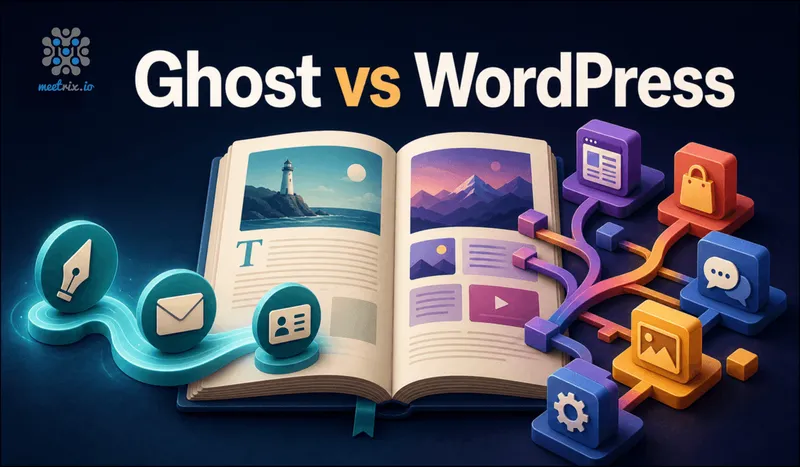
Most Ghost vs WordPress content compares feature checklists written for someone choosing a hosted SaaS plan. That's not the decision you're making if you're self-hosting on your own server. The real question is which one you want to be responsible for running: a lean, purpose-built publishing platform with a small attack surface, or a general-purpose CMS with an enormous plugin ecosystem and the patching burden that comes with it.
Quick answer
Jump to a section
Ghost: a publishing platform, not a general CMS
Ghost is MIT licensed and free to self-host on a VPS running Node.js and MySQL 8, managed through the ghost-cli tool. It was built specifically for publishing: posts, newsletters, paid membership tiers, and Stripe-powered subscriptions are core features, not add-ons. Ghost connects directly to Stripe for payments without taking an extra transaction fee on top. Self-hosting is genuinely free at the software level, though sending newsletters requires wiring up an external email provider like Mailgun, since Ghost doesn't run its own mail infrastructure for self-hosted instances.
Key facts
- MIT licensed, free to self-host, no plugin marketplace to patch
- Native memberships, paid subscriptions, and newsletter sending
- Direct Stripe integration for payments, no added transaction fee
- Requires an external email provider (e.g. Mailgun) for self-hosted newsletter delivery
WordPress: the general-purpose default
WordPress core is GPL licensed and free to self-host on PHP and MySQL or MariaDB. It powers well over 40% of all websites, which is both the appeal and the risk: that scale means a plugin exists for nearly anything you'd want to build, e-commerce via WooCommerce, forums, membership sites, portfolios, but it also makes WordPress the single most targeted CMS for automated exploit scans, precisely because so many sites run it. The official plugin directory alone lists over 60,000 free plugins, with tens of thousands more paid and independent options across the wider ecosystem.
Key facts
- GPL licensed, free core software, runs on PHP and MySQL/MariaDB
- Over 60,000 free plugins in the official directory alone
- Powers well over 40% of all websites globally
- Extendable into e-commerce, membership, forums, and far beyond blogging
Setup and the underlying stack
Ghost runs on Node.js with MySQL 8 as the database. For years the only supported install was ghost-cli on Ubuntu, which handles the install, SSL, and update process from the command line. Since Ghost 6 there's also an official Docker Compose setup, still labelled a preview, that bundles Ghost, MySQL and Caddy for TLS, and includes a script to move an existing ghost-cli site across. WordPress runs on PHP with MySQL or MariaDB, installed manually or through a one-click AMI, and updates happen through the WordPress admin dashboard or WP-CLI. Both are standard, well-documented Docker or VPS deployments that a small team gets running in under an hour. The difference shows up after launch: WordPress's stack has more moving parts once plugins and themes enter the picture, each with its own PHP dependencies and update cadence, where a self-hosted Ghost site typically stays close to its default install indefinitely.
Self-hosted Ghost vs hosted Ghost(Pro)
A lot of people comparing Ghost CMS vs WordPress haven't actually decided whether they want to run Ghost themselves. Ghost(Pro), the company's own hosting, takes care of updates, backups and email delivery. Its pricing starts with Starter at $18/month (about $15 on yearly billing) for up to 1,000 members, but Starter can't take paid subscriptions. For paywalls you need Publisher, from $29/month billed yearly, and the price climbs as your member count grows.
Self-hosted Ghost is the same software with none of those caps. The bill is a server plus an email provider. Ghost's own Docker docs use a 2GB, 1-vCPU droplet as their example, which is fine for a personal blog. Mailgun is the only bulk email service Ghost supports for newsletters, and it's billed separately. A few Ghost 6 features also lean on outside services when self-hosted: web analytics needs a Tinybird account, and the ActivityPub social web feature uses Ghost's hosted service by default (free up to 2,000 followers and 100 interactions a day) unless you run your own.
So here's how it splits: on a small list, Ghost(Pro) is cheap and removes all the ops work. Once you have several thousand members, the Ghost(Pro) price rises with every tier while a self-hosted server costs about the same at 500 members or 50,000, and Ghost blog hosting on your own box starts to make sense.
Security and the patching burden
This is where the self-hosting angle actually matters, and it's the part most feature-comparison articles skip. WordPress core itself is well audited and regularly patched, but the vast majority of real-world WordPress breaches come from outdated or poorly coded third-party plugins and themes, not core. Running WordPress self-hosted means you're responsible for keeping every installed plugin current, not just WordPress itself, and a single abandoned or unpatched plugin is enough to compromise the whole site.
Ghost's smaller footprint and lack of a plugin marketplace cut that risk down structurally: there's simply less third-party code running on your server to go stale. That's not a reason to skip updates, Ghost still ships security patches you need to apply, but the surface area you're responsible for patching is dramatically smaller.
Built-in publishing vs plugin-stacked publishing
Ghost's membership, paywall, and newsletter features work the moment you connect Stripe and an email provider, no additional software to install or configure beyond that. Matching the same functionality on WordPress usually means stacking two or three separate plugins, a membership plugin like MemberPress, an email plugin or Mailchimp integration, sometimes a separate paywall plugin, each maintained by a different developer, each a potential point of failure or conflict when one gets updated and another doesn't.
Ghost vs MemberPress
MemberPress is the plugin most WordPress sites reach for to sell memberships, so "Ghost vs MemberPress" is really the same question as this article from the paywall side. MemberPress is a paid plugin on a yearly license and handles more than Ghost does: courses, coupons, complex access rules, and integration with the rest of a WordPress site. Ghost's memberships are free, simpler, and tied to its newsletter, so a paid subscriber gets the posts in their inbox without any extra wiring. If you sell content and nothing else, Ghost does it with less to maintain. If memberships are one part of a bigger WordPress site, MemberPress fits where Ghost would mean running two systems.
Ghost Mailchimp integration (and why you may not need it)
Ghost has no built-in Mailchimp integration. It doesn't need one for newsletters, because it sends them itself. Teams that already have a Mailchimp audience usually connect the two through Zapier, or with a Ghost webhook on new members that calls Mailchimp's API. That's a reasonable bridge during a migration, but running both long-term means two subscriber lists that drift apart.
Cost
Both are free at the license level; the real cost lives in what you have to add to reach feature parity for publishing specifically. Ghost's added cost is predictable: server hosting plus an email provider like Mailgun, typically landing in the same general range as a decent WordPress hosting plan. WordPress's added cost is less predictable because it scales with how many premium plugins you end up needing, a membership plugin, a page builder, an SEO plugin, a backup plugin, each with its own subscription, and those add up faster than most people budget for going in.
Ghost vs WordPress: the facts
| Criterion | Ghost | WordPress |
|---|---|---|
| License | MIT | GPL |
| Stack | Node.js, MySQL 8 | PHP, MySQL/MariaDB |
| Official plugin/extension count | Small, curated integrations | 60,000+ in the official directory |
| Native memberships and paywalls | Yes, built in | Requires a third-party plugin |
| Native newsletter sending | Yes, with an external email provider | Requires a third-party plugin or service |
| Stripe payments | Direct integration, no added fee | Via plugin, fees vary by plugin |
| Market share (approx.) | Small, niche publishing tool | Well over 40% of all websites |
| Patching surface | Core software only | Core plus every installed plugin and theme |
| Best for | Blogging, newsletters, paid content | General-purpose sites, e-commerce, anything plugin-driven |
Where each one falls short
Ghost
- Small plugin ecosystem compared to WordPress, if a feature isn't built in, you may be building it yourself
- Self-hosted newsletter sending needs a separate email provider and its own monthly cost
- Not designed for e-commerce, forums, or general-purpose site building, it's a publishing tool by design, not a jack of all trades
WordPress
- Security is only as strong as your least-maintained plugin, and that risk grows with every plugin you add
- Matching Ghost's native newsletter and membership features means stacking multiple third-party plugins
- Plugin subscriptions for premium features add up to real recurring costs beyond the free core software
Ghost vs WordPress for self-hosting isn't really about which platform is more capable, WordPress wins that contest outright with its ecosystem. It's about how much third-party code you want running on your own server, and how much of that you're willing to patch yourself. If publishing is the whole job, Ghost's smaller footprint is worth the smaller plugin list. If the site needs to be more than a blog, WordPress's ecosystem earns its patching burden.
Our Ghost developer guide and Ghost AWS Marketplace guide cover the self-hosted setup end to end, Stripe and email provider included. If your project needs structured content beyond a blog, our Strapi and Directus guides cover the headless CMS route, which fits a custom frontend better than either Ghost or WordPress.
Frequently Asked Questions
Ghost vs WordPress: which is better for a self-hosted blog?
Ghost, if publishing and newsletters are the whole job, since paid subscriptions, membership tiers, and newsletter delivery are built in. WordPress, if you need a plugin for something beyond blogging, like e-commerce or a forum, its ecosystem covers use cases Ghost was never built for.
Is Ghost a good WordPress alternative for blogging specifically?
Yes, and it's built for that use case specifically rather than as a byproduct of being a general CMS. Native memberships, paid subscriptions, and newsletter sending are core Ghost features; on WordPress the same functionality means installing and maintaining third-party plugins.
What does a Ghost CMS review actually need to cover honestly?
The tradeoff: a leaner, purpose-built publishing platform with a much smaller plugin ecosystem than WordPress. Great if blogging and newsletters are the whole requirement, limiting fast if you need e-commerce, forums, or the tens of thousands of use-case-specific plugins WordPress has.
Which self hosted blog platform is more secure, Ghost or WordPress?
Ghost's smaller codebase and lack of a third-party plugin marketplace mean a smaller attack surface by default. WordPress's core is well audited, but its scale (powering well over 40% of the web) makes it the most targeted CMS, and most real-world WordPress breaches trace back to outdated or vulnerable plugins, not WordPress core itself.
Does self-hosted Ghost include newsletter sending for free?
The Ghost software is free either way, but self-hosted deployments need an external email provider like Mailgun to actually send newsletters, that's a separate monthly cost on top of your server. Ghost(Pro), the hosted version, includes email sending in the subscription price.
Ghost vs MemberPress: which is better for paid memberships?
If the site is mainly posts and a newsletter, Ghost: memberships, Stripe and email are built in and free. MemberPress makes sense when you're staying on WordPress, for example because you also sell courses or run WooCommerce. It's a paid plugin with a yearly license.
Does Ghost integrate with Mailchimp?
Not natively. Ghost sends newsletters itself (through Mailgun when self-hosted), so most sites drop Mailchimp. If you need to keep it, sync new members with Zapier or a webhook on the member.added event calling Mailchimp's API.
Should I use hosted Ghost(Pro) or self-host Ghost?
Ghost(Pro) starts at $18/month for 1,000 members and includes email sending; paid subscriptions need Publisher, from $29 billed yearly. Self-hosted Ghost costs a server plus Mailgun, and you do the updates. Self-hosting gets cheaper as your list grows.
Can WordPress do everything Ghost does for publishing?
With enough plugins, mostly yes, but that's the catch. Matching Ghost's built-in memberships, paywalls, and newsletter delivery on WordPress usually means stacking two or three separate plugins (for example MemberPress plus Mailchimp), each with its own settings, updates, and potential conflicts.
Launch Ghost on AWS in Minutes
Launch a pre-configured Ghost server on AWS, ready for publishing with SSL already set up, no PHP stack or plugin patching to manage.
Get Ghost on AWS Marketplace