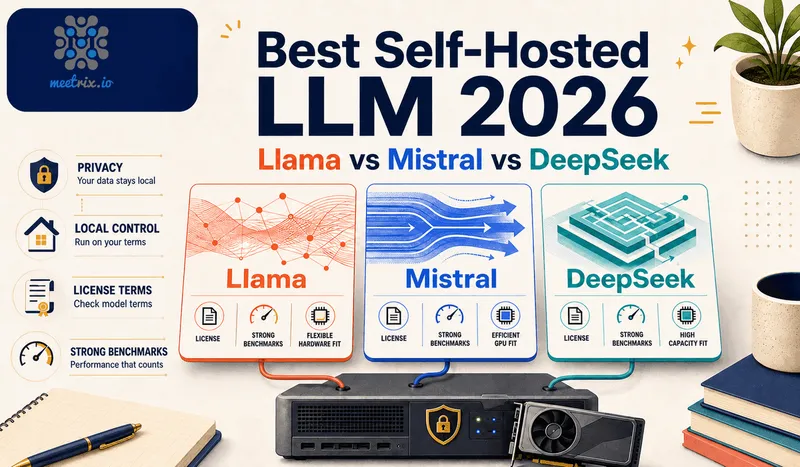
We ship AMIs for all three of these model families, so nothing here is riding on picking a winner. The best self hosted LLM question doesn't have one answer in 2026, because Llama, Mistral, and DeepSeek have genuinely diverged: different licenses, different specialties, and wildly different hardware footprints depending on which variant in each family you actually run.
Quick answer
Jump to a section
How to choose between Llama, Mistral, and DeepSeek
Skip the leaderboard scrolling, three questions cover most of the real decision:
- What's the primary task, reasoning and code, or general use? DeepSeek's R1 and V3.2 lines specifically lead on math, coding, and competitive-programming benchmarks. Llama and Mistral are stronger generalists. If coding is the actual job, our best open-source LLMs for self-hosted coding comparison ranks all three families on HumanEval, SWE-bench, and VRAM specifically for that use case.
- Does the license term matter at your scale? Llama 4's Community License requires a separate agreement past 700 million monthly active users, irrelevant for nearly everyone self-hosting, but worth knowing if you're building something that might genuinely reach that scale.
- What GPU are you actually running this on? Family doesn't determine hardware requirements, the specific variant does. A distilled DeepSeek model and a small Llama model can both run on modest hardware; the flagship version of any of the three needs serious multi-GPU infrastructure.
1. Llama 4: massive context windows, Meta's Community License
Llama 4 ships in two main variants with meaningfully different profiles, detailed on Meta's official Llama site. Scout fits on a single NVIDIA H100 and offers an industry-leading 10 million token context window, useful for tasks that need to reason over an entire codebase or a large document set in one pass. Maverick handles a 1 million token context and beats GPT-4o and Gemini 2.0 Flash on many multimodal benchmarks, scoring 85.5% on MMLU and an ELO of 1417 on LMArena, using less than half the active parameters DeepSeek V3 uses for comparable work. Both ship under Meta's Llama 4 Community License, which allows commercial use but requires a separate license agreement once a product exceeds 700 million monthly active users.
Key facts
- Scout: 10M token context, fits on a single H100
- Maverick: 1M token context, MMLU 85.5%, strong multimodal performance
- Llama 4 Community License: commercial use allowed, separate agreement needed past 700M MAU
- Efficient relative to parameter count against DeepSeek V3 on comparable tasks
2. Mistral: Apache 2.0 across the board, strong multilingual support
Mistral's biggest shift into 2026 is licensing: Mistral Large 3, a 675B-parameter open-weight mixture-of-experts model documented on Mistral's own technology page, ships under Apache 2.0 with no usage-scale conditions attached, a genuine change from Mistral's historically more restrictive terms on its largest models. It supports a 128k context window and 80-plus languages, making it a strong pick for multilingual deployments specifically. Mistral's smaller models (the Mixtral MoE line, Mistral Small) have long been Apache 2.0 as well, so the family is now consistently permissive top to bottom rather than gating the flagship behind a different license.
Key facts
- Mistral Large 3: 675B parameters, MoE architecture, Apache 2.0 licensed
- 128k context window, strong support across 80+ languages
- No usage-scale restrictions anywhere in the current lineup
- Smaller Mistral and Mixtral models also Apache 2.0, consistent licensing across the family
3. DeepSeek: the reasoning and coding specialist, MIT licensed
DeepSeek's R1 line, published on the DeepSeek AI GitHub organization, was the breakthrough story of 2025 into 2026, and the R1-0528 update pushed AIME 2025 math accuracy from 70% to 87.5%. DeepSeek R1 scores 97.3% on MATH-500, and DeepSeek V3.2-Speciale won gold at the IMO, IOI, and ICPC competitions in 2026, genuinely elite results for an open-weight model. DeepSeek V3.2 scores 94.2% on MMLU, competitive with GPT-4o on general knowledge, while DeepSeek V4 Pro scales up to 1.6T total parameters (49B active) in its largest MoE configuration. The full model line ships MIT licensed, the most permissive license type available, no conditions at all. If you specifically want the coding-focused variant, our DeepSeek Coder deployment guide covers the AWS AMI setup.
Key facts
- DeepSeek R1: 97.3% on MATH-500, major AIME 2025 accuracy gains after the R1-0528 update
- DeepSeek V3.2-Speciale: gold-medal results at IMO, IOI, and ICPC 2026
- DeepSeek V4 Pro: 1.6T total parameters, 49B active (MoE architecture)
- MIT licensed across the model line
Licensing: the real differences
Llama vs Mistral on licensing isn't close: Mistral Large 3's Apache 2.0 has no usage-scale condition, while Llama 4's Community License requires Meta's sign-off once a product crosses 700 million monthly active users. That threshold won't matter to almost anyone self-hosting for internal use or a smaller product, but it's a real, specific term worth knowing rather than assuming all "open weight" models carry identical rights. Llama vs DeepSeek on licensing is more clear-cut: DeepSeek's MIT license carries no conditions of any kind, the most permissive option of the three families for fine-tuning, redistribution, and commercial deployment.
Hardware: what you actually need to self host llm aws deployments
Model family doesn't determine your GPU requirement, model size does, and this is where most comparisons get vague. A distilled or smaller-parameter variant from any of the three families, in the 7B to 14B range, runs comfortably on a single mid-tier GPU instance. The flagship configurations are a different story entirely: Mistral Large 3 at 675B parameters and DeepSeek V4 Pro at 1.6T total parameters both need multi-GPU infrastructure to run at full precision, even with mixture-of-experts architecture reducing the active parameter count per token. Llama 4 Scout is the outlier worth calling out specifically, its 10M context window fits on a single H100, unusually efficient for that scale of context.
Llama vs Mistral vs DeepSeek: feature comparison
| Criterion | Llama 4 | Mistral | DeepSeek |
|---|---|---|---|
| License | Llama 4 Community License | Apache 2.0 | MIT |
| Usage-scale restriction | Yes, past 700M MAU | None | None |
| Flagship context window | 10M (Scout), 1M (Maverick) | 128k | Varies by variant |
| Strongest specialty | Long-context, multimodal | Multilingual, general use | Math, code, reasoning |
| Key benchmark result | MMLU 85.5% (Maverick) | 128k context, 80+ languages | MATH-500 97.3% (R1) |
| Flagship parameter count | Not publicly detailed at Maverick scale | 675B (Large 3, MoE) | 1.6T total, 49B active (V4 Pro) |
| Fits on a single high-end GPU | Scout variant, yes | Smaller variants only | Distilled variants only |
Why we deploy all three families
Most teams that come to us don't actually want to pick a single model family forever, they want to test which one performs best on their specific workload before committing infrastructure to it. That's the whole reason we standardized on OpenWebUI with Ollama as our default deployment: it serves models from Llama, Mistral, and DeepSeek interchangeably through the same interface, so switching from a Llama model to a DeepSeek model for a coding task doesn't mean standing up separate infrastructure, it's a model swap in the same running instance.
Our OpenWebUI with Ollama guide covers that setup end to end. For family-specific deployments, our Llama 3 and Llama 4 developer guides, Mistral developer guide, and DeepSeek Coder developer guide each cover the dedicated install path, and our Llama 3 installation guide walks through the AWS setup specifically. If you are choosing the engine that serves these models, our vLLM vs SGLang comparison covers the two main options. And if the plan is a RAG chatbot on top of the model, built on a canvas instead of in code, we compare the visual builders in Flowise vs Langflow vs n8n.
Where I'd start
Math, code, or reasoning-heavy workloads: DeepSeek, the benchmark lead is real and the MIT license removes any licensing friction. Need the least restrictive license possible or strong multilingual support: Mistral Large 3. Working with very long documents or codebases in a single context window: Llama 4 Scout.
Whichever family you pick, size the model to your actual GPU budget first. The flagship variant of any of these three is a serious infrastructure commitment; a smaller or distilled model from the same family often gets you 90% of the useful capability at a fraction of the hardware cost.
Frequently Asked Questions
What is the best self hosted LLM in 2026?
There's no single winner across every use case. DeepSeek leads on math and reasoning benchmarks and ships MIT licensed. Mistral Large 3 is the most permissively licensed of the three flagships (Apache 2.0, no usage-scale restrictions). Llama 4 Scout fits on a single H100 with a 10M token context window, useful for long-document work specifically.
Llama vs Mistral: which has the better license?
Mistral Large 3 ships under Apache 2.0 with no usage restrictions at all. Llama 4 uses Meta's Community License, which permits commercial use but requires a separate agreement once a product exceeds 700 million monthly active users, a threshold that won't affect most self-hosted deployments but is worth knowing about.
Llama vs DeepSeek: which performs better on reasoning tasks?
DeepSeek, by a clear margin on published benchmarks. DeepSeek R1 scores 97.3% on MATH-500, and DeepSeek V3.2-Speciale won gold at the IMO, IOI, and ICPC in 2026. Llama 4 Maverick is competitive on general multimodal benchmarks (MMLU 85.5%) but isn't the reasoning specialist DeepSeek's R1 line is.
What is a fair open source llm comparison summary for self-hosting?
All three ship genuinely open weights you can self-host. The real differences are license terms (Mistral's Apache 2.0 is the least restrictive), specialty (DeepSeek for math and reasoning, Llama 4 Scout for extremely long context), and hardware footprint, which varies enormously between each family's smallest and largest variants.
What do I actually need to self host llm aws deployments for these models?
Model size drives this, not family. A distilled or smaller variant (7B-14B range) runs on a single mid-tier GPU instance. The full flagship models (Mistral Large 3 at 675B, DeepSeek V4 Pro at 1.6T total parameters) need multi-GPU instances. Most self-hosted deployments run a smaller distilled variant, not the flagship.
Can I run all three families on the same self-hosted setup?
Yes. We deploy OpenWebUI with Ollama specifically because it can serve models from any of the three families interchangeably, switch between a Llama, Mistral, or DeepSeek model from the same interface without standing up separate infrastructure for each.
Launch OpenWebUI with Ollama on AWS
Launch a pre-configured server on AWS ready to run Llama, Mistral, or DeepSeek models interchangeably, no separate infrastructure per model family.
Get OpenWebUI with Ollama on AWS Marketplace