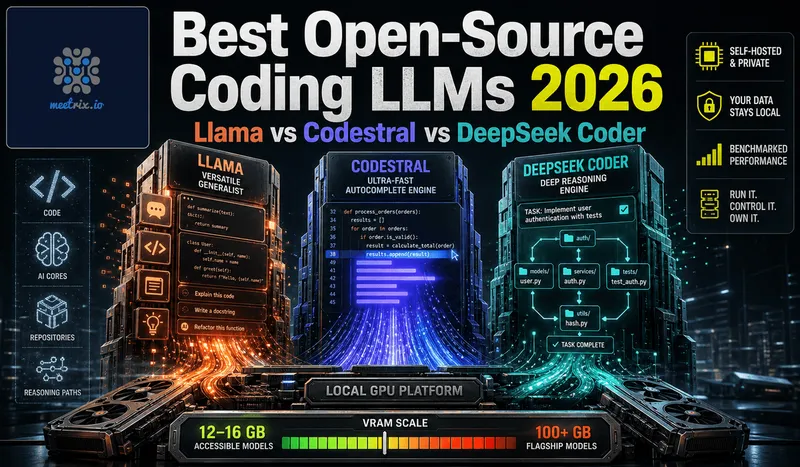
Most Llama vs Mistral vs DeepSeek writeups compare general reasoning, licensing, and context windows. Fair questions, but if the actual reason you're self-hosting one of these is to write, complete, or review code, that comparison answers the wrong thing. DeepSeek Coder, Code Llama, and Mistral's Codestral are the three real options for a best local coding llm in 2026, and they don't rank the same way the general-purpose versions of these families do.
We ship AMIs across all three families, so this isn't a pitch for one over the others. Here's the coding-specific breakdown: real HumanEval, SWE-bench, and VRAM numbers, not a rebadged general-purpose comparison.
Quick answer
Jump to a section
How to choose a self-hosted coding LLM
Three questions matter more than the family name:
- Autocomplete, or full task completion? Fast in-editor suggestions and deep reasoning over a whole coding task are different jobs. Codestral is built for the first, DeepSeek Coder for the second.
- How much VRAM do you actually have? Distilled coding models fit in 12-16 GB, comfortable on a single mid-tier GPU. Full flagship coding models need 100+ GB and a genuinely different infrastructure budget.
- Do you need a coding specialist, or one model for everything? If code is one of several tasks, not the only one, a strong generalist like Llama 3 70B may be the simpler pick over standing up a dedicated coding model.
1. Llama and Code Llama: the dedicated coding model got passed by the generalist
Code Llama, Meta's original dedicated coding fine-tune, remains usable but is no longer the sharpest tool in the family for the job it was built for. Llama 3 70B now scores higher on Python benchmarks (74% vs Code Llama's 71%) and supports up to 128K tokens of context, a meaningful advantage for understanding a real repository rather than an isolated function. That's an unusual pattern, normally a specialized fine-tune stays ahead of the generalist it's based on, but continued investment in mainline Llama's coding ability, documented on Meta's official Llama site, has closed and passed that gap.
Key facts
- Llama 3 70B: 74% on Python benchmarks, ahead of Code Llama's 71%
- 128K token context in current Llama versions, far beyond Code Llama's original window
- Code Llama 34B remains viable for narrow, specialized coding tasks specifically
- Llama 4 Community License, commercial use allowed, separate agreement past 700M MAU
2. Mistral and Codestral: built for fill-in-the-middle speed
Codestral, Mistral's dedicated code model, is tuned specifically for fill-in-the-middle completion, the task of predicting code in the middle of a file rather than only at the end, which is what in-editor autocomplete actually needs. Codestral 25.12, detailed on Mistral's own Codestral page, leads dense open-weight models on HumanEval-FIM and runs comfortably on 16 GB of VRAM, a genuinely accessible footprint for a single-GPU workstation or a modest cloud instance. It's not tuned to be the deepest reasoner over a full coding task, that's a different job, it's tuned to be fast and accurate at the exact moment a developer is typing.
Key facts
- Codestral 25.12 leads dense open-weight models on HumanEval-FIM specifically
- Runs on roughly 16 GB VRAM, accessible on a single mid-tier GPU
- Apache 2.0 licensed, consistent with the rest of the Mistral family
- Tuned for fill-in-the-middle speed over deep multi-step reasoning
3. DeepSeek Coder: the deepest reasoner, in a size that actually fits
DeepSeek Coder V2 32B-Instruct scores 92.7% on HumanEval and 87.2% on HumanEval+, and the full DeepSeek Coder V3, a 236B-parameter mixture-of-experts model documented on the DeepSeek Coder GitHub repo, competes directly with Claude 3.5 Sonnet and GPT-4o on HumanEval, SWE-bench, and LiveCodeBench. That flagship needs 100+ GB of memory to hold, a serious infrastructure commitment. The distilled version is the practical option for most self-hosted setups: DeepSeek Coder V3 (Distilled) delivers 40.5% on SWE-bench Verified in roughly 12 GB of VRAM, the best quality-per-GB of any coding model in this comparison. Our DeepSeek Coder deployment walkthrough covers the AWS Marketplace setup end to end.
Key facts
- DeepSeek Coder V2 32B-Instruct: 92.7% HumanEval, 87.2% HumanEval+
- Full DeepSeek Coder V3: 236B MoE, competes with Claude 3.5 Sonnet and GPT-4o, needs 100+ GB memory
- Distilled variant: 40.5% SWE-bench Verified in roughly 12 GB VRAM
- MIT licensed across the model line, no usage conditions
Coding benchmarks that actually matter
General LLM leaderboards (MMLU, LMArena) don't tell you much about coding ability specifically. The benchmarks worth checking for a coding model are HumanEval and HumanEval+ (function-level correctness, defined in OpenAI's HumanEval repo), SWE-bench Verified (real GitHub issue resolution, a much harder and more realistic test, tracked on the SWE-bench leaderboard), and HumanEval-FIM (fill-in-the-middle, the actual task autocomplete performs). DeepSeek Coder V2 32B leads on raw HumanEval, DeepSeek Coder V3 Distilled leads on SWE-bench Verified per GB of VRAM, and Codestral leads on HumanEval-FIM specifically. None of the three families wins across all three benchmark types, which is exactly why the "best" answer depends on whether you're building autocomplete or an agent that resolves full tickets. If it's the latter and you'd rather wire the agent loop visually than in code, Flowise can orchestrate that on top of any of these self-hosted models.
Self host llm aws: VRAM for coding models
Coding models follow the same rule as general-purpose ones, size determines hardware, not family. Codestral and DeepSeek Coder V3 (Distilled) both fit in the 12-16 GB VRAM range, comfortable on a single mid-tier GPU instance, genuinely accessible for a small team. The full DeepSeek Coder V3 at 236B parameters needs 100+ GB of memory, multi-GPU territory. Llama 3 70B sits in between depending on quantization. If you're testing which coding model actually fits your workflow before committing infrastructure, starting with a distilled or smaller variant and upgrading later is the lower-risk path.
Best local coding LLM: feature comparison
| Criterion | Llama 3 70B | Codestral 25.12 | DeepSeek Coder V3 (Distilled) |
|---|---|---|---|
| License | Llama 4 Community License | Apache 2.0 | MIT |
| Python benchmark | 74% | Optimized for FIM, not this metric | Strong on HumanEval+ (parent line) |
| SWE-bench Verified | Not the specialty | Not the specialty | 40.5% |
| Fill-in-the-middle (FIM) | Supported, not the focus | Leads dense open models | Supported, not the focus |
| Approx. VRAM needed | Varies by quantization | ~16 GB | ~12 GB |
| Context window | 128K tokens | 32K tokens | Varies by build |
| Best for | One model for code and general use | In-editor autocomplete | Full coding tasks, code review |
Not looking for a coding specialist?
If your actual question is which of these three families to run for general reasoning, long-context document work, or the most permissive license overall, not specifically coding, that's a different comparison, and we've already written it. Our Llama vs Mistral vs DeepSeek: Best Self-Hosted LLM in 2026 breakdown covers licensing terms, context windows, and general benchmark performance across all three flagship families in full.
Where I'd start
Building in-editor autocomplete where response speed is the whole point: Codestral. Building an agent or workflow that needs to resolve real coding tasks, not just suggest the next line: DeepSeek Coder V3 (Distilled), the best quality-per-GB of the three. Want one model that handles coding reasonably well alongside everything else you're using it for, without standing up a second specialist model: Llama 3 70B.
Whichever you pick, start with the distilled or smaller variant. The flagship version of any of these three is a serious infrastructure commitment, and a smaller model gets real coding work done on hardware most self-hosted teams already have.
Our DeepSeek Coder developer guide, Mistral developer guide, and Llama 4 and Llama 3 developer guides each cover the dedicated install path, and we explain the hardware and license side of running Llama 4 Scout on AWS separately. Our OpenWebUI with Ollama guide covers running any of these interchangeably from one interface. For the serving engine underneath, see our vLLM vs SGLang comparison.
Frequently Asked Questions
What is the best local coding LLM in 2026?
DeepSeek Coder V3 (Distilled) for the best quality per GB of VRAM, 40.5% on SWE-bench Verified in around 12 GB. Mistral's Codestral 25.12 for fast in-editor autocomplete specifically. Llama 3 70B if you want one model that handles coding and general tasks well, since mainline Llama has caught up to and passed the older dedicated Code Llama models.
Is Code Llama still worth using in 2026?
Not really as a first choice. Llama 3 70B now beats Code Llama on Python benchmarks (74% vs 71%) and supports up to 128K tokens of context against Code Llama's much shorter window, better for understanding a real repository. Code Llama still works, but mainline Llama and dedicated coding models like DeepSeek Coder and Codestral have moved past it.
What is the best open source llm for someone who wants one general-purpose model, not a coding specialist?
That's a different question than the coding-specific one, and it's the one our other Llama vs Mistral vs DeepSeek comparison answers in full, covering licensing, context windows, and general reasoning benchmarks across all three families.
DeepSeek Coder vs Codestral: which is better for autocomplete in my editor?
Codestral 25.12, it leads dense open-weight models on HumanEval-FIM, the benchmark that specifically tests fill-in-the-middle completion, and runs comfortably on 16 GB VRAM. DeepSeek Coder's strength is deeper reasoning over a full coding task, not fast inline suggestions.
What do I need to self host llm aws instances for a coding-focused model?
It depends on the specific variant, not the family. A distilled coding model fits in roughly 12-16 GB VRAM, comfortable on a single mid-tier GPU instance. The full DeepSeek Coder V3 is a 236B-parameter MoE model needing 100+ GB of memory, a genuinely different infrastructure commitment.
Can I run a coding-focused model and a general-purpose model on the same self-hosted setup?
Yes. We deploy OpenWebUI with Ollama specifically because it serves models from Llama, Mistral, and DeepSeek interchangeably, switch from a coding-focused model to a general-purpose one from the same interface without standing up separate infrastructure.
Launch OpenWebUI with Ollama on AWS
Launch a pre-configured server on AWS ready to run coding-focused or general-purpose models from Llama, Mistral, or DeepSeek, no separate infrastructure per model.
Get OpenWebUI with Ollama on AWS Marketplace