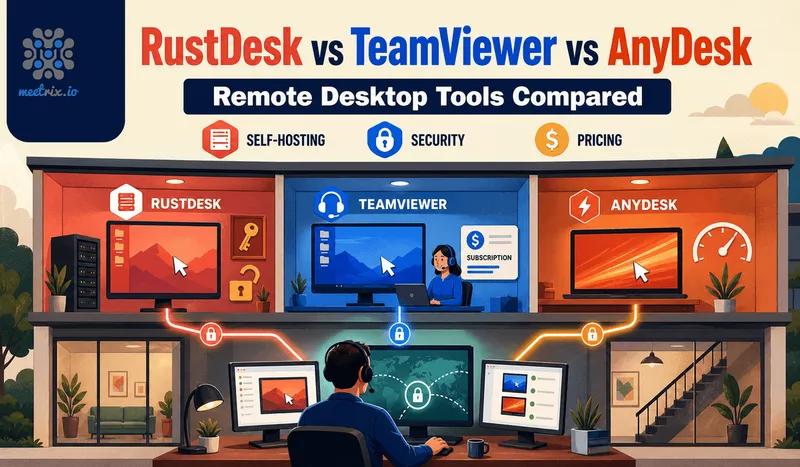
We package RustDesk as an AWS AMI, so weigh that against everything below. RustDesk vs TeamViewer isn't close on price, RustDesk vs AnyDesk is closer than most people assume. AnyDesk can self-host too, just not for free, and that distinction gets lost in most "best remote desktop tool" roundups that lump TeamViewer and AnyDesk together as equally cloud-locked.
Quick answer
Jump to a section
1. RustDesk: open source, self-hosted by default
RustDesk is written in Rust and released under the AGPL-3.0 license, with the client and the self-hosted relay and rendezvous server (hbbr and hbbs) both free to run. Self-hosting means your session data routes through a server you control rather than a third party's relay, a real difference for anyone with data-residency or compliance concerns. The self-hosting docs cover the open source server.
Server Pro is the optional paid tier, billed yearly. Individual is $11.88/month (1 login user, 20 managed devices) and adds a web console, address book, audit log and 2FA. Basic is $23.88/month (10 users, 100 devices) and adds LDAP and OIDC single sign-on. None of that is required for basic self-hosted remote access, which remains free.
Key facts
- Open source (AGPL-3.0), free client and self-hosted server
- Written in Rust, source code publicly auditable
- Server Pro Individual from $11.88/month for a web console and address book
- Basic plan at $23.88/month adds LDAP and SSO/OIDC for 10 users, 100 devices
2. TeamViewer: polished and audited, cloud-only at any price
TeamViewer is the most established name in remote desktop software, and it earns that reputation with genuinely deep feature coverage, multi-monitor handling, session recording, and years of security audits most competitors can't match. What it doesn't offer, at any tier including its enterprise Tensor product, is a self-hosting option. It's cloud-only, full stop. Business pricing runs $50.90/month billed annually, roughly $611 a year, for a single technician, and TeamViewer is known for aggressively flagging free-tier accounts that show commercial usage patterns, then locking them until you upgrade.
Key facts
- No self-hosting option at any tier, cloud-only including Tensor (enterprise)
- Business plan: $50.90/month per technician (~$611/year)
- Deep feature set: multi-monitor, session recording, extensive audit history
- Free tier is personal-use only and actively detects suspected commercial use
3. AnyDesk: commercial software with a paywalled self-hosting tier
AnyDesk is free for personal, non-commercial use. Its paid plans are billed yearly and, at list price, run $24.90/month for Solo (one user, one connection), $42.90/month for Standard (one connection, up to 20 users, session recording) and $90.90/month for Advanced (two connections, up to 100 users). AnyDesk regularly discounts the first year, so check the page before you budget. Unlike TeamViewer, AnyDesk does offer a genuine self-hosted option: its Ultimate plan can run in the cloud or on-premises, with data staying inside your network. The catch is that Ultimate is custom quoted, not a box you tick on the standard plans.
Key facts
- Free for personal use only, paid plans from $24.90/month (list, billed yearly)
- On-premises hosting: genuine self-hosting, but Ultimate-tier and custom quoted
- Standard and Advanced tiers add session recording and larger team management
- Proprietary, closed source, unlike RustDesk
RustDesk vs AnyDesk: performance and everyday use
Price aside, the question people actually ask is whether RustDesk feels as good as AnyDesk. Mostly, yes, with one caveat that comes down to how each one moves the picture.
AnyDesk built its own codec, DeskRT, specifically for low-latency remote desktop over bad connections, and on a weak hotel or mobile link that's where it still has an edge. RustDesk uses standard video codecs (VP8, VP9, AV1, plus hardware H.264 and H.265 where the GPU supports it) and tries a direct peer-to-peer connection first, falling back to your relay server only when NAT gets in the way.
That fallback is the caveat. When a session does go through the relay, its speed depends on where you put that server. A relay in the same region as your technicians and users is fine for everyday support work. A relay on the other side of the world adds lag you'll notice when scrolling or typing. We haven't run a controlled benchmark, so there are no numbers here, but in practice the fix is simple: host the relay near the people using it.
The self-hosting question, answered accurately
Most "best remote desktop tool" comparisons treat TeamViewer and AnyDesk as equally locked to the cloud, and that's not accurate. TeamViewer has never offered a self-hosting path at any price. AnyDesk does, through its on-premises Ultimate plan, but that tier is custom quoted, not something a small team can simply download and run the way RustDesk's server works. RustDesk is the only one of the three where self-hosting is the default, free, open source experience rather than a gated enterprise feature. If self-hosting is the actual requirement, not just a nice-to-have, that distinction changes which of the three even qualifies.
Cost at scale: RustDesk vs TeamViewer vs AnyDesk for five technicians
For a five-technician support team, five TeamViewer Business licenses come to roughly $3,050 a year, with no self-hosting option regardless of spend. AnyDesk prices by concurrent connection: Standard with four add-on connections ($25.90 each per month) lands near $1,760 a year at list price, Advanced with three add-ons near $2,020, and self-hosting still means a custom-quoted Ultimate contract on top. RustDesk's self-hosted core costs nothing beyond your server, and Server Pro Basic, which covers 10 login users, is about $287 a year.
RustDesk vs TeamViewer vs AnyDesk: feature comparison
| Feature | RustDesk | TeamViewer | AnyDesk |
|---|---|---|---|
| License | Open source (AGPL-3.0) | Proprietary | Proprietary |
| Self-hosting available | Yes, free and default | No, at any tier | Yes, Ultimate tier only |
| Free tier cost | $0, full self-hosted access | Personal use only, flagged if commercial | Personal use only |
| Commercial pricing (billed yearly) | $11.88-$23.88/month (optional Server Pro) | $50.90/month (Business) | $24.90-$90.90/month (list) |
| Session recording | Via Server Pro | Built in | Standard tier and up |
| LDAP / SSO | Basic plan and up | Enterprise tiers | SSO on Ultimate |
| Best for | Cost-sensitive, self-hosting-first teams | Enterprises wanting the most audited, established option | Teams wanting polish with an eventual self-hosting path |
Why we run RustDesk for clients
Most teams that come to us evaluating remote desktop tools have already priced out TeamViewer for a five- or ten-person support team and didn't like the number, especially once they realize self-hosting isn't an option there at any price. RustDesk removes both problems: the core software is free, and self-hosting is the default deployment model, not a feature you have to negotiate an enterprise contract to unlock. We package it as a ready-to-launch AMI so the relay and rendezvous server setup, normally a bit fiddly to configure correctly, is done before the instance finishes booting.
Our RustDesk developer guide and AWS installation guide cover the self-hosted setup in full, and our GCP developer guide and GCP Marketplace listing cover that platform too. If you want the fuller case for why we build on RustDesk specifically, this article covers that in more depth.
Where I'd start
Cost-sensitive, want self-hosting as the default rather than a negotiated add-on: RustDesk. Need the most polished, most audited option and self-hosting isn't a requirement: TeamViewer, accepting the cost. Want commercial polish now with a self-hosting path available later, and can justify an Ultimate contract eventually: AnyDesk.
If self-hosting is the actual reason you're reading this, not just a preference, RustDesk is the only one of the three where that's the default experience rather than a feature you have to unlock.
Frequently Asked Questions
RustDesk vs TeamViewer: which is actually cheaper?
RustDesk, by a wide margin. The core client and self-hosted server are free under an open source license. TeamViewer's Business plan runs $50.90/month, roughly $611 a year, for a single technician, with no self-hosting option at any price.
RustDesk vs AnyDesk: what's the real difference for a team?
Both can self-host, but RustDesk's self-hosted server is free and open source from the start. AnyDesk's on-premises option exists only on its Ultimate tier, which is custom quoted, not something you download and run for free the way RustDesk's server works.
Is RustDesk self hosted actually free?
Yes. The client and self-hosted relay/rendezvous server are free under the AGPL-3.0 license. RustDesk Server Pro is an optional paid tier from $11.88/month (billed yearly) that adds a web console, address book and audit log, but core self-hosted remote access costs nothing.
Is there a genuine teamviewer alternative self hosted option?
RustDesk is the clearest one. TeamViewer has no self-hosting option at any tier, including its enterprise Tensor product, it's cloud-only. RustDesk gives you a free, open source server you run yourself, with your session data never touching a third party's relay.
What is a genuinely open source remote desktop tool?
RustDesk. It's written in Rust and released under an open source license (AGPL), with the source code publicly auditable. TeamViewer and AnyDesk are both proprietary, closed-source products, even where AnyDesk offers an on-premises deployment option.
Does TeamViewer flag free accounts used for business?
Yes, and it's a common complaint. TeamViewer's free tier is licensed for personal use only, and the software actively detects usage patterns that look commercial (frequent connections, business-hours usage) and can lock the account, forcing an upgrade to a paid plan.
Is RustDesk better than AnyDesk?
On cost and control, yes: RustDesk self-hosts for free and AnyDesk only self-hosts on its custom-quoted Ultimate tier. AnyDesk is the more polished product, with tighter latency on poor connections and a bigger admin feature set out of the box.
Is RustDesk free for commercial use?
Yes. The open source client and server are AGPL-3.0 and can be used commercially at no cost. You only pay if you want Server Pro features such as the web console, LDAP or OIDC single sign-on.
Launch RustDesk on AWS in Minutes
Launch a pre-configured RustDesk server on AWS, self-hosted remote access with the relay server already set up, no per-technician license fee.
Get RustDesk on AWS Marketplace