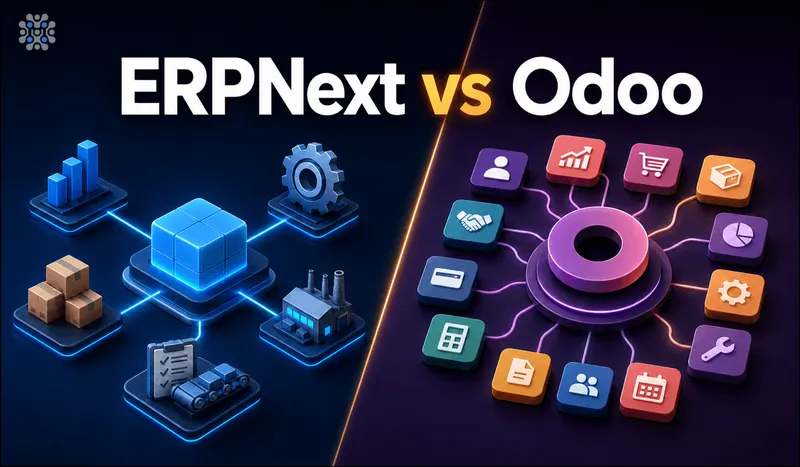
"ERPNext vs Odoo" is a genuinely hard call, and we say that having deployed both. Most vendor-written comparisons pick a winner because they're selling one of the two. We're not in that position, we package both as AWS AMIs, so this is the version of the comparison with nothing riding on which one you pick.
Both cover the same ground at a high level, accounting, inventory, manufacturing, CRM, HR, in a single open source platform you can self-host. Where they genuinely differ is licensing structure, how much of "the whole ERP" is actually free, and which ecosystem fits your business type better.
Quick answer
Jump to a section
How to choose between ERPNext and Odoo
Skip the module-by-module spec sheet, three questions cover most of it:
- Do you need full accounting on day one? ERPNext ships complete accounting free. Odoo Community only covers basic invoicing and bookkeeping, full accounting and advanced reporting are Enterprise-only.
- How much do you value a large app ecosystem? Odoo's marketplace and 5 million-plus user base mean more pre-built integrations and more consultants who already know it. ERPNext's ecosystem is smaller but the core platform covers more for free.
- Is your business manufacturing-heavy? ERPNext's bill-of-materials, job cards, and production planning feel like first-class citizens in the free edition. Odoo can do manufacturing too, but the deeper tools lean toward Enterprise.
Odoo: the largest open source ERP ecosystem
Odoo's Community Edition is LGPL-v3 and free to self-host, covering core CRM, sales, inventory, and basic accounting. The Enterprise Edition adds full accounting with dynamic reports, an app builder (Studio), the mobile app, IoT support, WhatsApp integration, and around 40 other modules, priced per user and month, plus official support and Odoo.sh managed hosting. With more than 5 million users and 50-plus official apps, it has by far the larger ecosystem of the two.
Key features
- 50+ official apps covering nearly every business function
- Massive third-party module marketplace built over more than a decade
- Polished UI with a large, dedicated design and UX team
- Studio app builder for no-code customization (Enterprise)
- Odoo.sh managed hosting option if you don't want to self-host
Pros
- By far the largest app ecosystem and consultant pool available
- Community Edition is a genuinely usable free starting point
- Polished, modern UI across the whole platform
Cons
- Full accounting and around 40 modules require paid Enterprise
- Per-user Enterprise pricing adds up fast for larger teams
- Community Edition needs OCA's free add-on modules to close some feature gaps
ERPNext pricing vs Odoo pricing
ERPNext pricing is the simpler story: self-hosted, it's whatever your server costs, typically $10 to $100 a month depending on scale, with zero per-user or per-module fee at any tier. Frappe Cloud managed hosting exists if you'd rather not run the server yourself, starting around $5 a month for a small site.
Odoo's Community Edition is free to self-host the same way, but that's not the whole ERP. The moment you need full accounting, advanced reporting, or most of the other 40-plus Enterprise modules, you're on a paid per-user plan, roughly $25 to $40 per user per month depending on plan and region, with real variance by country. For a small team that needs full accounting from day one, that cost shows up immediately rather than growing into it.
ERPNext vs Odoo: feature comparison
| Feature | ERPNext | Odoo |
|---|---|---|
| License | GPLv3, one edition | LGPL-v3 (Community) + proprietary Enterprise |
| Full accounting | Free, included | Enterprise-only |
| Manufacturing / BOM | Free, first-class feature | Basic in Community, deeper tools in Enterprise |
| Official apps / modules | Core ERP modules | 50+ official apps |
| Third-party marketplace | Smaller | Large, decade-plus mature |
| Pricing past free tier | None, same license at any scale | ~$25-40/user/month (Enterprise, varies by region) |
| Managed hosting option | Frappe Cloud | Odoo.sh |
| Best for | Manufacturing-heavy, cost-sensitive teams | Broad app needs, larger consultant ecosystem |
Why we deploy both for clients
We don't lead clients toward one of these by default, the honest answer depends on what the business actually runs on. Manufacturing and production-heavy clients tend to land on ERPNext because the shop-floor features are free and well-built. Clients who need Odoo's specific app ecosystem, or who are already budgeting for Enterprise-tier accounting anyway, go with Odoo. Both ship as ready-to-launch AWS AMIs from us, so the setup overhead is the same either way, the decision comes down to the software, not the deployment friction.
Our ERPNext developer guide and ERPNext AWS AMI guide cover that deployment in full, and the Odoo developer guide plus Odoo AMI setup guide do the same for Odoo.
Where I'd start
Cost-sensitive, manufacturing-heavy, or you want the whole ERP without an eventual Enterprise upsell: ERPNext. Need the widest possible app ecosystem, or you're already planning to pay for Enterprise-tier accounting anyway: Odoo.
Both are real, production-grade open source ERPs. The wrong move here isn't picking either one, it's picking based on which sales page you read first instead of which modules your business actually needs for free.
Frequently Asked Questions
ERPNext vs Odoo: which is actually free?
ERPNext is GPLv3 with no separate paid edition, everything including accounting and manufacturing is free to self-host. Odoo's Community Edition is free too, but full accounting, advanced reporting, and 40-plus other modules sit behind the paid Enterprise Edition.
Odoo vs ERPNext: which has more integrations?
Odoo, by a wide margin. It has 50+ official apps and a huge official and third-party marketplace built over more than a decade with 5 million-plus users. ERPNext covers the core ERP workflows well but has a smaller app ecosystem around it.
What is a good open source ERP comparison for a manufacturing business?
ERPNext tends to fit manufacturing workflows more naturally out of the box, bill of materials, job cards, and production planning are first-class features in the free edition. Odoo can do it too, but deeper manufacturing tools lean toward Enterprise.
ERPNext pricing vs Odoo: what's the real cost difference?
Self-hosted ERPNext costs whatever your server costs, full stop, no per-user fee at any tier. Self-hosted Odoo Community is the same for basic use, but once you need full accounting or the extra Enterprise modules, you're paying roughly $25 to $40 per user per month (varies by region and plan).
Is Odoo Community missing features compared to Enterprise?
Yes, notably full accounting, advanced reporting, and around 40 other modules are Enterprise-only. The OCA (Odoo Community Association) maintains over 1,000 free modules that fill many of these gaps, but it's extra setup work Enterprise skips.
Which is easier to customize, ERPNext or Odoo?
ERPNext's Frappe framework is generally considered friendlier for building custom apps and reports without deep ORM knowledge. Odoo's framework is powerful and mature but has a steeper learning curve for developers new to it.
Launch ERPNext on AWS in Minutes
Launch a pre-configured ERPNext server on AWS, with accounting, inventory, and manufacturing ready to use out of the box.
Get ERPNext on AWS Marketplace