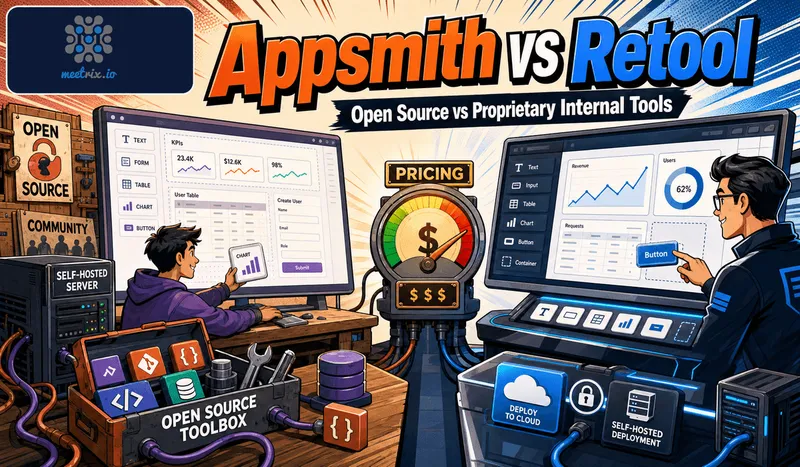
Most of what ranks for Appsmith vs Retool comes from Appsmith or Retool themselves, understandably, but not the same as an independent read. We package Appsmith as an AWS AMI, so we're not neutral either, but the honest version is this: Retool's integration library and polish are real advantages, and Appsmith's pricing, especially once you actually understand what self-hosting Retool costs, is a real advantage too.
Quick answer
Jump to a section
Appsmith: open source, free self-hosting with no user cap
Appsmith's Community Edition is open source and free to self-host, with no cap on users and no license fee for the core builder. It covers drag-and-drop UI building, database and REST/GraphQL API connections, and JavaScript logic for custom behavior, the core of what most internal tools actually need. Commercial features are split across two tiers: audit logs, custom roles, unlimited Git repos and environments come with Business ($15/user/month, up to 99 users), while SAML or OIDC single sign-on and SCIM provisioning need Enterprise (from $2,500/month for 100 users). None of that is required to self-host and build real applications on the free edition.
Key facts
- Open source Community Edition, free, self-hosted, no user cap
- Drag-and-drop UI builder with JavaScript for custom logic
- Business: $15/user/month (up to 99 users), adds audit logs and custom roles
- Enterprise: from $2,500/month for 100 users, adds SAML/OIDC SSO and SCIM
Retool: mature, broad integrations, priced the same whether self-hosted or not
Retool is the more established name in internal tools, with a mature builder and a broader integration library covering more enterprise data sources out of the box than most competitors. The free tier covers up to 5 users, Team runs $10 per builder per month ($12 monthly), and Business runs $50 per builder per month billed annually or $65 billed monthly, plus lower pricing for internal users who only use published apps ($5 on Team, $15 on Business). Enterprise is custom quoted. Retool does offer self-hosted deployment on every plan, but past the free 5 users it charges the same per-user pricing regardless of where the app actually runs (Retool's pricing page, checked October 2026).
Key facts
- Free tier covers up to 5 users
- Team: $10/builder/month, Business: $50-65/builder/month
- Broader, more mature integration library than Appsmith's
- Self-hosted deployment available, free up to 5 users, then the same price as Retool Cloud
Is Retool open source?
No, and that's the single most searched question around this comparison. Retool is proprietary. The self-hosted version is Retool's own closed Docker images, deployed with the configs in their public retool-onpremise repo, and running them past 5 users needs a paid license key. Having a public deployment repo on GitHub doesn't make the product open source, which is where a lot of the confusion comes from.
If open source is an actual requirement (for an audit, a procurement rule, or because you want to patch the code yourself), Retool is out. Appsmith's Community Edition is on GitHub under Apache-2.0, and ToolJet and Budibase are the other two names that come up.
The retool self hosted pricing surprise
This is the detail worth being direct about, because it trips people up. Self-hosting usually implies "free, or at least cheaper," and for most open source tools that's true. Retool breaks that pattern: there is a free self-hosted plan, but only for 5 users. Past that, whether your app runs on Retool's cloud or your own server, you pay the same per-builder price, $50 to $65 a month on Business, and the Team and Business self-hosted plans stop at 100 users. Unlimited users, SSO and air-gapped installs are Enterprise-only. Self-hosting Retool buys you data residency and infrastructure control, not a lower bill. Appsmith is the opposite case entirely, self-hosting is where the free tier actually lives.
Cost at team scale
For a 10-developer team, Appsmith Business runs $150 a month. The same team on Retool Business runs $500 to $650 a month, self-hosted or not. Over a year, that's roughly $1,800 versus $6,000 to $7,800, a gap that compounds every year the team keeps growing. Teams that don't need Retool's deeper integration library or its more mature builder specifically are paying a meaningful premium for capability they may not be using.
Which integration gap actually matters
Before assuming Retool's broader library is worth the price difference, check the specific integrations your team actually needs, not the total count either vendor advertises. Appsmith covers the common ground well: PostgreSQL, MySQL, MongoDB, REST APIs, GraphQL, and the usual cloud databases. Where Retool genuinely pulls ahead is in niche enterprise connectors, specific SaaS platforms, less common data warehouses, things a smaller fraction of teams actually touch. If your stack is standard databases and REST APIs, that gap may never show up in practice. If you're connecting to something specific and unusual, verify Appsmith supports it (directly or via a generic REST/GraphQL wrapper) before ruling it in or out on cost alone.
Retool vs Appsmith for enterprise apps
For an enterprise rollout the price per seat matters less than three checkboxes security will ask about: single sign-on, audit logs, and source control. Both products put SSO behind their top tier, so budget for Enterprise on either side if SAML is non-negotiable.
- Single sign-on: Retool needs Enterprise. Appsmith gives Google sign-in for free, SAML and OIDC on Enterprise.
- Audit logs: Retool Business (on cloud) and Enterprise. Appsmith Business and Enterprise.
- Git source control: Retool Enterprise only. Appsmith lets the free tier connect 3 Git repos and Business unlimited, which matters more than it sounds once two developers edit the same app.
- Scale: Retool's self-hosted Team and Business plans stop at 100 users; Appsmith Business stops at 99, and both push you to Enterprise past that.
My read: if your enterprise app is a handful of admin panels on Postgres and REST, Appsmith Business plus Enterprise SSO later is the cheaper path. If you're wiring dozens of SaaS systems together and need Retool's connectors, compare against its Enterprise plan, not Business.
Appsmith vs Retool: feature comparison
| Criterion | Appsmith | Retool |
|---|---|---|
| License / model | Open source (Community Edition) | Proprietary |
| Free self-hosted tier | Yes, no user cap | Up to 5 users, then same price as cloud |
| Business tier pricing | $15/user/month | $50-65/builder/month |
| Free tier user cap | Unlimited (Community Edition) | 5 users |
| Integration library | Common databases, REST/GraphQL | Broader, more mature |
| SAML/OIDC SSO | Enterprise | Enterprise |
| Audit logs | Business and up | Business (cloud) and up |
| Git source control | Free (3 repos), Business unlimited | Enterprise |
| Best for | Cost-sensitive teams building common internal tools | Teams needing deep, varied integrations |
Where each one falls short
Appsmith
- Smaller integration library than Retool's more mature ecosystem
- Commercial features still require a paid tier: audit logs on Business, SAML SSO on Enterprise
- Self-hosting means owning server setup, updates, and backups
Retool
- Self-hosting doesn't reduce cost past 5 users, same per-builder price as cloud
- Free tier caps at 5 users, restrictive for a growing team
- Per-builder pricing compounds fast for larger development teams
Appsmith vs Retool isn't a case of one clearly outclassing the other, Retool's integration depth and polish are real, earned advantages. It comes down to whether that depth is worth $500-650 a month for a mid-size team when Appsmith covers the same core workflow, drag-and-drop UI, database connections, custom logic, for a fraction of the cost and a genuinely free self-hosted path.
Our Appsmith developer guide and AWS deployment guide cover the self-hosted setup in full. If your team needs a broader no-code database alongside the internal tools builder, our NocoBase developer guide and custom database AWS guide cover that adjacent piece.
Frequently Asked Questions
Appsmith vs Retool: which is actually cheaper?
Appsmith, and the gap widens the more people you add. Appsmith's Business plan is $15 per user per month; Retool's Business plan runs $50-65 per builder per month. For a 10-developer team, that's roughly $150 a month on Appsmith versus $500-650 on Retool.
What is retool self hosted pricing, really?
Free for up to 5 users, then the same per-user price as Retool Cloud: Team at $10 per builder per month and Business at $50 (billed yearly), both capped at 100 users self-hosted. Unlimited users and SSO need Enterprise. Self-hosting buys data control, not a discount.
Is Retool open source?
No. Retool is proprietary software. You can self-host it with Docker or Kubernetes, but you run Retool's closed images under a paid license past 5 users. Appsmith, ToolJet and Budibase are the open source alternatives people usually compare it with.
Is there a genuine retool alternative open source option?
Appsmith. Its Community Edition is genuinely open source and free to self-host with no user cap, covering drag-and-drop UI building, database and API connections, and JavaScript logic, the core of what most Retool users actually build.
What is a good internal tools builder for a cost-sensitive team?
Appsmith, specifically because self-hosting is free at any team size. Retool is a strong product too, but its self-hosted option costs the same as its cloud plans, so the cost-sensitive path only really exists on Appsmith's side.
Does Appsmith's free plan have real limits like Retool's free tier?
Appsmith's self-hosted Community Edition has no user cap at all. Audit logs and custom roles need Business, and SAML or OIDC single sign-on needs Enterprise, but the core builder is unrestricted. Retool's free tier caps at 5 users, cloud or self-hosted.
Which has better integrations, Appsmith or Retool?
Retool's integration library is broader and more mature, a real advantage for teams connecting to a wide range of enterprise data sources. Appsmith covers the common databases and REST/GraphQL APIs well but has fewer pre-built connectors overall.
Launch Appsmith on AWS in Minutes
Launch a pre-configured Appsmith server on AWS, self-hosted with no user cap and no per-seat pricing on the core builder.
Get Appsmith on AWS Marketplace