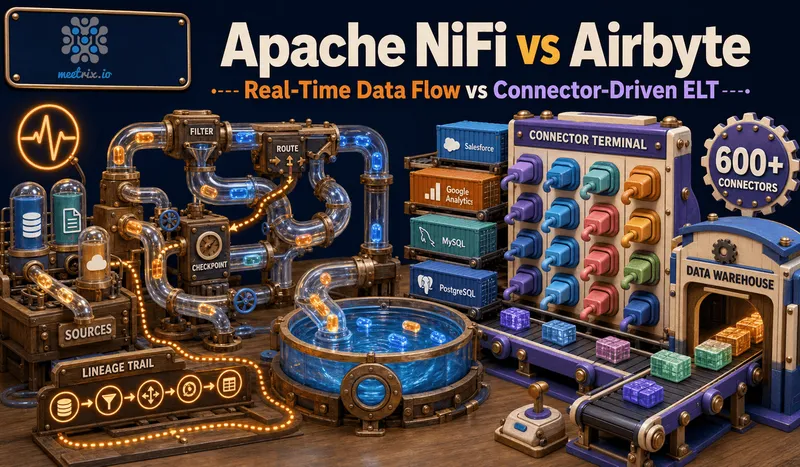
Nifi vs Airbyte isn't really an apples-to-apples fight, and most comparisons that treat it that way miss the point. Apache NiFi is a general-purpose dataflow automation tool: it moves data as individual flow files in real time, routes it conditionally across systems, and tracks the full lineage of every record it touches. Airbyte is an ELT platform built around a library of 600+ prebuilt connectors, its job is getting data from a source into a warehouse with as little setup as possible, then letting dbt or SQL handle the transformation.
Apache NiFi vs Airbyte comes down to what you're actually building: a continuous, auditable dataflow between systems, or a fast path to load a warehouse from a long list of sources. Here's the honest breakdown of both, including what each one actually costs to run yourself.
Quick answer
Jump to a section
Apache NiFi: real-time dataflow with full lineage
Apache NiFi is Apache 2.0 licensed and originated at the NSA as Niagarafiles before being donated to the Apache Software Foundation in 2014, graduating to a top-level project the following year. It processes data as individual flow files rather than batch jobs, giving it sub-second latency for time-sensitive pipelines, with a visual, drag-and-drop interface for building and monitoring routing logic. Its standout feature is provenance: every flow file carries a full chain of custody, so you can trace exactly where a piece of data came from, what touched it, and even replay it from any point in the pipeline. The current release is NiFi 2.12.0 (September 2026). In February 2026 the project voted to deprecate the separate NiFi Registry, slated for removal in NiFi 3.0, in favor of the Git-based flow registry clients (GitHub, GitLab, Bitbucket, Azure DevOps) built into NiFi 2.
Key facts
- Apache 2.0 licensed, fully free to self-host with no feature gating
- Flow-file based processing, sub-second latency for real-time pipelines
- Full data provenance and lineage tracking, replay from any point in the flow
- Visual, drag-and-drop interface for building conditional routing logic
Airbyte: an ELT platform built on a connector library
Airbyte launched in 2020 and has grown its connector library to more than 600 sources and destinations by 2026, the reason most teams reach for it first. Its core platform and connectors are licensed under the Elastic License v2, with the underlying Airbyte Protocol released under MIT, and the ELv2 terms mainly restrict repackaging Airbyte as a competing hosted service, not ordinary self-hosted use. Its ELT-first architecture loads raw data into your warehouse as-is, then leaves transformation to dbt or SQL downstream, an intuitive interface makes setting up a new sync straightforward even for less technical users. Cloud pricing starts at $10/month plus usage, with Plus and Pro tiers requiring a custom quote.
Key facts
- Elastic License v2 for the core platform and connectors, MIT for the Airbyte Protocol
- 600+ prebuilt connectors as of 2026, its main differentiator
- ELT-first: loads raw data into a warehouse, transformation happens afterward via dbt or SQL
- Cloud tiers start at $10/month plus usage; self-hosted Open Source edition is free software
Dataflow automation vs ELT: the real difference
This is where most nifi vs airbyte comparisons stop at a feature checklist, and it deserves more than that. NiFi treats data movement as a continuous, observable flow: each record is a flow file with attributes and a lineage trail, and you can route it conditionally based on content, apply backpressure when a downstream system slows down, and see exactly what happened to it at every step. Airbyte treats data movement as a sync job: pull from a source connector, land it in a destination, done, then transformation happens as a separate step in the warehouse. If your problem is moving events between systems in real time with an audit trail, NiFi's model fits. If your problem is getting data from 40 SaaS tools into a warehouse without custom-coding each connector, Airbyte's model fits, and NiFi would be substantial overkill for that job.
Self-hosting and cost
NiFi's Apache 2.0 license means self-hosting costs nothing beyond your own infrastructure, no feature is gated behind a paid tier. Airbyte's self-hosted Open Source edition is also free software, but the realistic cost isn't zero: expect 40 to 80 hours of initial setup on Kubernetes or Docker, then $500 to $3,000 or more a month in infrastructure at production scale, plus 20 to 40 hours a month of ongoing maintenance. Airbyte Cloud removes that operational burden starting at $10/month plus usage-based fees, a fair tradeoff if your team would rather pay than run Kubernetes. NiFi doesn't have an equivalent managed cloud tier from the project itself, self-hosting or a managed AWS deployment like ours is the practical path either way.
Apache NiFi use cases
NiFi earns its complexity in a specific set of situations:
- Real-time IoT and sensor ingestion: sub-second flow-file processing handles continuous streams from devices better than a scheduled batch sync.
- Complex conditional routing: sending different records to different destinations based on content, without writing custom orchestration code.
- Data lineage and compliance: industries that need to prove exactly where a piece of data came from and what transformed it get that for free from NiFi's provenance repository.
- Edge data collection: MiNiFi, NiFi's lightweight edge agent, collects data close to the source before it reaches a central flow.
- Legacy system integration: NiFi's broad processor library handles older protocols and formats that a modern ELT connector catalog often doesn't cover.
Where Airflow and dbt fit: NiFi vs Airflow vs Airbyte
A lot of people searching this are really comparing three or four tools at once, because data stacks get described as one blob. They're different layers.
- Apache Airflow is an orchestrator. It runs Python-defined DAGs on a schedule and makes sure step B starts after step A finishes. It doesn't move or transform data itself; it calls the tools that do.
- Airbyte is the loader: source connector in, warehouse out.
- NiFi is the router for data that never stops arriving, with lineage on every record.
- dbt is the transformation layer inside the warehouse.
dbt vs NiFi
These two get compared more than they should. dbt only works on data that's already in a warehouse: you write SQL models, it builds tables and views and tests them. NiFi works before the warehouse, moving and reshaping records in flight. If your question is "how do I turn raw tables into clean reporting tables," that's dbt. If it's "how do I get these device events from 40 sites into Kafka and S3 without losing any," that's NiFi.
The common open source stack ends up looking like this: Airbyte loads the warehouse, dbt models it, Airflow runs the two in order every night. NiFi joins only when something has to flow continuously instead of on a schedule. If you're starting from zero and your sources are SaaS apps and databases, I'd skip NiFi and start with Airbyte plus dbt.
Apache NiFi vs Airbyte: the facts
| Criterion | Apache NiFi | Airbyte |
|---|---|---|
| Core model | Real-time dataflow, flow-file based | ELT, connector-based batch sync |
| License | Apache 2.0 | Elastic License v2 (core), MIT (protocol) |
| Latency | Sub-second, event-driven | Scheduled, primarily batch |
| Connector library | Broad processor set, general-purpose | 600+ purpose-built connectors |
| Data lineage | Full provenance, replay from any point | Not a core feature |
| Self-hosting cost | Free, no feature gating | Free software, real infra and setup time |
| Managed cloud option | None from the project itself | Airbyte Cloud from $10/month plus usage |
Where each one falls short
Apache NiFi
- Steeper learning curve than a connector-and-click ELT tool, it's a general-purpose platform, not a narrow one
- No purpose-built connector catalog on the scale of Airbyte's 600+, more manual configuration per source
- NiFi Registry's deprecation (removal planned for NiFi 3.0) means teams still on it need to plan a move to Git-based flow versioning
Airbyte
- Primarily batch-oriented, a poor fit for genuinely real-time or event-driven pipelines
- Self-hosting is free software but not free effort, real Kubernetes setup and maintenance time
- Some community-built connectors don't meet enterprise-grade reliability standards
Apache NiFi vs Airbyte isn't a contest either one wins outright, it's a question of what you're moving and how. Real-time, auditable dataflow with complex routing points to NiFi. Fast, low-code loading of a warehouse from a long list of sources points to Airbyte. Plenty of data teams end up running both for different jobs.
Our Apache NiFi developer guide covers the full setup, and our Apache NiFi on AWS deployment guide walks through launching the pre-configured AMI. If your pipeline also needs dashboards downstream of NiFi, our Grafana developer guide covers that, and our MongoDB developer guide covers a common NoSQL destination for flows that don't need a relational warehouse.
Frequently Asked Questions
Apache NiFi vs Airbyte: what's the fundamental difference?
NiFi is a general-purpose dataflow automation tool built for real-time, event-driven routing with full data lineage. Airbyte is an ELT platform built around a library of 600+ prebuilt connectors that load raw data into a warehouse for transformation afterward. One moves data continuously and traces every hop, the other ingests from many sources with minimal setup.
Is Apache NiFi or Airbyte better for streaming data?
NiFi. It processes data as individual flow files with sub-second latency and built-in backpressure, designed for continuous, event-driven pipelines. Airbyte is primarily a batch tool, syncs run on a schedule rather than processing events as they happen.
Is Apache NiFi free to self-host?
Yes, fully. NiFi is Apache 2.0 licensed with no usage restrictions, self-host it and use every feature at zero software cost.
Is Airbyte actually free to self-host?
The software is free under the Elastic License v2, but self-hosting isn't zero-cost. Expect 40 to 80 hours of initial setup on Kubernetes or Docker, plus roughly $500 to $3,000+ a month in infrastructure and 20 to 40 hours a month of ongoing maintenance at production scale.
What are the best Apache NiFi use cases?
Real-time IoT and sensor ingestion, complex conditional routing across many systems, data lineage and audit trails for compliance, edge data collection through MiNiFi, and integrating legacy systems that speak protocols a typical ELT connector doesn't support.
dbt vs NiFi: do they do the same job?
No. dbt transforms data that's already in your warehouse, using SQL models. NiFi moves data between systems before it lands anywhere. Teams often use both: NiFi or Airbyte to load the warehouse, dbt to model it afterwards.
Apache NiFi vs Airflow vs Airbyte: which one do I need?
Airflow schedules and orchestrates jobs, it doesn't move data itself. Airbyte loads warehouses through connectors. NiFi routes streaming data with lineage. A common stack is Airbyte for loading, dbt for modeling and Airflow to run them in order; NiFi comes in when data must flow continuously.
For an open source data integration tool focused on loading a warehouse, which should I pick?
Airbyte. Its 600+ connector library is purpose-built for pulling data from SaaS tools and databases into a warehouse for dbt or SQL transformation. NiFi can technically do this too, but it's a heavier, more general-purpose tool for a job Airbyte was designed around specifically.
Launch Apache NiFi on AWS in Minutes
Launch a pre-configured Apache NiFi server on AWS, ready for real-time dataflow automation with full lineage tracking, no manual setup required.
Get Apache NiFi on AWS Marketplace