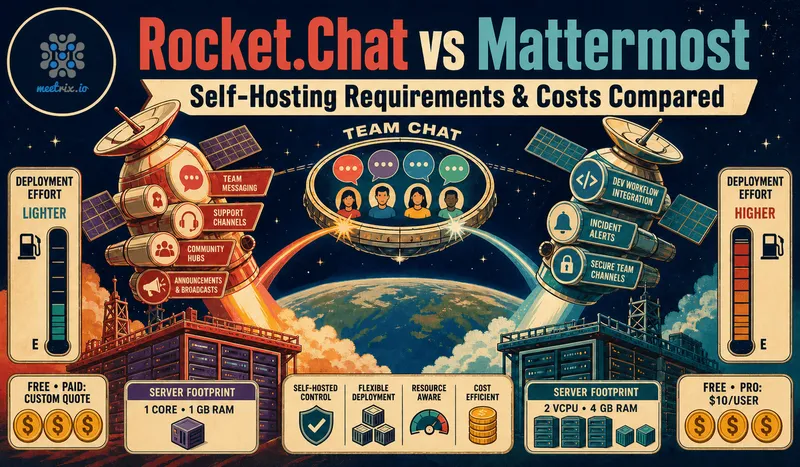
Most Rocket.Chat vs Mattermost writeups start and end with features. That's fair, but it skips the question that actually determines your monthly bill and your ops workload: what does running each one yourself take, and what does the next tier up actually cost? Both are genuinely free, MIT licensed, self-hosted team chat platforms, and Meetrix packages both as AWS AMIs, so this isn't a sales pitch dressed as a comparison. Here's the hosting-first version: server requirements, deployment options, and real Mattermost vs Rocket.Chat pricing.
Quick answer
Jump to a section
Rocket.Chat: MIT licensed, five ways to deploy it
Rocket.Chat has two free self-managed routes. Starter is free for up to 50 users and exposes many premium features for evaluation and small, non-critical teams. Community is the MIT-licensed build with no per-seat software charge, but Rocket.Chat now describes it as a basic, non-critical option capped at 100 concurrent users and 10,000 push notifications per month. Its Node.js and MongoDB stack supports Docker, Kubernetes, the Launchpad CLI, Snap, and cloud marketplace AMIs, including ours on AWS.
Key facts
- Starter: $0 for up to 50 users; Community: $0 software license with documented operational limits
- Five official deployment models, from a Snap test install to a Kubernetes Helm chart
- Node.js server backed by MongoDB, standard Docker Compose setup for a small team
- Omnichannel routing (WhatsApp, SMS, live chat) included in the free edition
Mattermost: open-source core, annual paid licensing
Mattermost's open-source Team Edition has no per-seat software fee. Paid self-hosted features come through Professional and Enterprise subscriptions. Mattermost sells those as prepaid annual licenses per activated user: deactivated users do not count at renewal, single-channel guests are free up to a 1:1 ratio with paid seats, and users who access multiple guest channels count as paid activated users. Professional supports up to 250 users, but its current pricing page says Contact Sales rather than publishing a dollar figure.
Key facts
- Open-source Team Edition with no per-seat software charge
- Go server with PostgreSQL or MySQL, deployed via Docker, Kubernetes, or source
- Professional and Enterprise are prepaid annual subscriptions priced by sales quote
- Professional licenses are billed per activated user and support up to 250 users
- Enterprise scales to 50,000 concurrent users, 200,000 on Enterprise Advanced
Rocket Chat hosting requirements: what the server actually needs
This is where most "rocket chat hosting" searches are really headed, and the honest numbers are small at the low end. Rocket.Chat's own docs list a minimal setup, up to 200 users with 50 concurrent, as a single 2 GHz core and 1 GB RAM. A small deployment up to 500 users with 100 concurrent wants dual-core and 2 GB RAM, and anything past 500 concurrent users needs 4 or more vCPU and 8+ GB RAM. For larger installs past 5,000 concurrent users, Rocket.Chat recommends 16 vCPU and roughly 12 GiB of memory.
Mattermost's current Linux deployment guide lists 1 vCPU and 2 GB RAM for the application server, with support for up to 1,000 users under light usage. That is only the application floor. Mattermost explicitly recommends keeping PostgreSQL on a separate system for production, so a realistic production budget is the app server plus a database, storage, backups, and monitoring. Our AWS AMIs remove the installation work, but the AWS infrastructure remains part of your monthly bill.
Build your own chat server: Docker, Kubernetes or an AMI
Both projects give you the usual routes to a chat server self hosted on your own infrastructure. Rocket.Chat ships Docker Compose files, a Kubernetes Helm chart, a Snap package for quick tests and marketplace images. Mattermost offers Docker, a Kubernetes operator and Linux packages, and its docs walk through each in the deployment guide. For a single team, Docker Compose on one VM is enough; Kubernetes only earns its complexity once you need high availability. If you'd rather skip the install, our Rocket.Chat AMI and Mattermost on AWS guides start from a working server.
Mattermost vs Rocket.Chat pricing
Both can start with a $0 software license, but “free software” is not the same as free operations. Rocket.Chat's Starter and Community plans cost nothing to license within their limits. The retired Pro plan is no longer available to new buyers as of April 29, 2026; Commercial, Government, and Defense plans are custom-quoted. Mattermost Professional and Enterprise are also quote-based today, despite older comparisons still repeating a $10/user/month figure. Professional is prepaid annually per activated user and capped at 250 users.
For an accurate procurement comparison, ask both vendors for the same seat count, support response time, SSO requirements, high-availability rights, non-production licenses, and contract term. A low seat price can be misleading if staging, premium support, mobile security, compliance, or multiple production instances are separate line items.
What does self-hosting cost per month?
The table below uses current AWS Lightsail Linux bundles with public IPv4 as a simple, public infrastructure benchmark - not as a deployment recommendation or a quote for our AWS Marketplace products. Lightsail currently lists 1 GB at $7/month, 2 GB at $12/month, 4 GB at $24/month, and 8 GB at $44/month. EC2 pricing varies by region, processor, purchase model, storage, and data transfer.
| Cost scenario | Rocket.Chat | Mattermost |
|---|---|---|
| Evaluation / tiny team | 1 GB server benchmark: about $7/month | 2 GB app server benchmark: about $12/month |
| Small production team | 2 GB server benchmark: about $12/month; add backups | 2 GB app server ($12) + separate small database from about $15 = roughly $27/month before backups |
| More active deployment | 4 GB server benchmark: about $24/month | 4 GB app server ($24) + database from $15-$30 = roughly $39-$54/month |
| 8 GB application tier | About $44/month before database, storage, and backups | About $44/month before database, storage, and backups |
| Paid software | Commercial, Government, or Defense: custom quote | Professional or Enterprise: annual, per-activated-user sales quote |
These are infrastructure floors, not complete invoices
The self-hosting costs most comparisons leave out
- Backups and retention: message databases, uploaded files, and snapshot history all grow over time. Budget for the live volume and at least one separate backup destination.
- Outbound data: file downloads, mobile clients, integrations, and calls consume transfer. Bundled transfer can hide this initially; overages become relevant for media-heavy teams.
- Email and push delivery: password resets and notifications may need an SMTP service. Rocket.Chat Community also documents a 10,000 monthly push-notification limit.
- Voice and video: reliable calling may require a TURN server. Mattermost deployments with more than 50 Calls users need RTCD, and recording or transcription adds a separate Calls Offloader service.
- High availability: redundant app nodes, database failover, load balancers, and shared object storage can turn a $12 single-server test into a multi-node production architecture.
- Administration: even two hours of engineering work per month can cost more than the VM. Include patching, upgrades, security reviews, restore tests, monitoring, and incident response in total cost of ownership.
- Paid support and compliance: SSO, audit controls, mobile management, SLAs, air-gapped operation, and regulated-industry requirements can move either platform from free software to a custom commercial agreement.
Open source chat server comparison: the self-hosting facts
| Criterion | Rocket.Chat | Mattermost |
|---|---|---|
| License (free tier) | MIT (Community) | MIT (Team Edition) |
| Documented app minimum | 1 core, 1 GB RAM (minimal deployment) | 1 vCPU, 2 GB RAM (Linux application server) |
| Underlying stack | Node.js, MongoDB | Go, PostgreSQL or MySQL |
| Deployment models | Docker, Kubernetes, Launchpad CLI, Snap, cloud AMI | Docker, Kubernetes, source binary |
| Paid tier price | Custom quote | Custom quote, prepaid annually per activated user |
| Free-plan limit | Starter: 50 users; Community: up to 100 concurrent users | Team Edition has no per-seat software fee |
What if features, not hosting, decide it?
Server specs and pricing aren't always the deciding factor. If your real question is whether you need customer-facing omnichannel support (WhatsApp, SMS, live chat routed into your team's inbox) versus internal-only team chat, that's a feature question, not a hosting one, and we cover it feature by feature in our other Rocket.Chat vs Mattermost breakdown, including scale numbers and where each tool falls short.
Where I'd start
Choose Rocket.Chat if the smallest single-server bill matters and its Starter or Community limits fit your team. Choose Mattermost if you prefer its developer-focused workflow and PostgreSQL architecture, and you are comfortable budgeting for a separate production database. Once paid features enter the decision, neither product has a public self-serve price today: collect matched quotes and compare the full three-year cost, not a remembered per-user number from an older pricing page.
Our Rocket.Chat developer guide and Rocket.Chat AWS setup guide cover the self-hosted install end to end. If Mattermost fits better, our Mattermost developer guide covers that path, and our Mattermost vs Slack comparison is worth a look if a SaaS tool is still on the table. For a wider view of self-hosted options beyond these two, see our best collaboration tools on AWS Marketplace roundup.
Frequently Asked Questions
Rocket.Chat vs Mattermost: which one is actually cheaper to run?
For a small single server, Rocket.Chat has the lower floor: its 1 GB minimum is about $7/month on an AWS Lightsail Linux bundle, against about $12/month for Mattermost's 2 GB minimum, which also wants a separate production database. Paid licenses for both now need a sales quote.
Is Rocket.Chat self hosted really free?
Yes, within limits. Starter is free for up to 50 users with many premium features. Community is MIT licensed with no per-seat fee, documented for basic use with up to 100 concurrent users and 10,000 push notifications a month. Commercial, Government and Defense plans are custom-priced.
What's the minimum server I need for Rocket Chat hosting?
Rocket.Chat's own docs put a minimal setup, up to 200 users with 50 concurrent, at a single 2 GHz core and 1 GB RAM. Past 500 concurrent users, plan for 4 or more vCPU and 8+ GB RAM.
Mattermost vs Rocket.Chat pricing: what does the paid tier actually cost?
Neither vendor currently publishes a simple self-serve paid price. Rocket.Chat retired Pro for new purchases on April 29, 2026, and quotes Commercial, Government, and Defense plans. Mattermost now lists Professional as Contact Sales; licenses are prepaid annually per activated user, with Professional capped at 250 users.
Which needs the smaller server for a small team just getting started?
Rocket.Chat if the smallest possible infrastructure bill or future customer-facing communication matters. Mattermost if your team prefers PostgreSQL, developer-focused workflows, and can budget for a separate production database. For paid editions, request quotes from both vendors instead of relying on older per-user prices.
What deployment options does Rocket.Chat support besides Docker?
Five official paths: Docker or Docker Compose, a Kubernetes Helm chart for microservices scaling, the Launchpad CLI installer, a Snap package for quick testing, and cloud marketplace AMIs, including ours on AWS, for a pre-configured server with no manual setup.
Launch Rocket.Chat on AWS in Minutes
Launch a pre-configured Rocket.Chat server on AWS, right-sized and ready, no manual MongoDB setup or server-spec guesswork required.
Get Rocket.Chat on AWS Marketplace