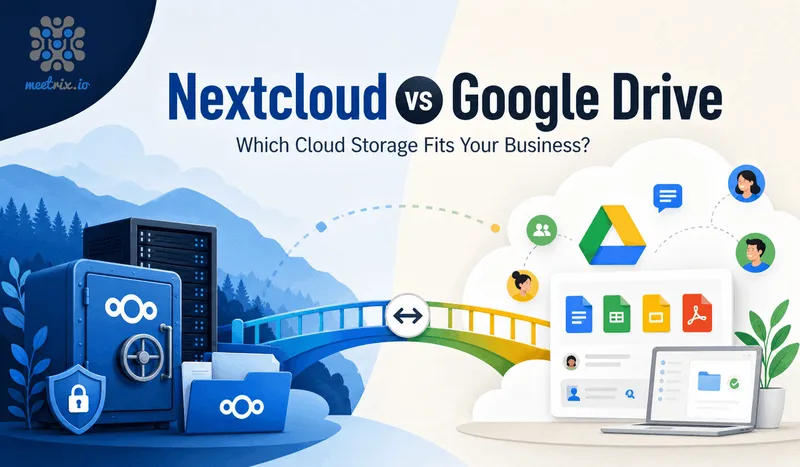
Nextcloud vs Google Drive usually gets compared on sync speed and app polish, which misses the actual business decision. Google Drive is fast, familiar, and requires zero server maintenance. Nextcloud is self-hosted, and once you self-host, the question of who legally controls your company's files changes completely, even if Google stores those files on a server physically sitting in Europe.
Quick answer
Jump to a section
Nextcloud: file sync and groupware you host yourself
Nextcloud's Community Edition is AGPL-3.0 licensed and free to self-host with unlimited users and apps. Nextcloud Hub bundles Files (sync and sharing), Talk (video and voice calls), Groupware (calendar and contacts), and Office (collaborative document editing) into one platform. The Hub 26 Winter release added an on-prem AI Assistant with support for self-hosted models like Olmo 3, IBM watsonx, and Llama, so even the AI features stay off third-party servers. Storage is whatever disk you attach to the server, there's no per-user cap built into the software.
Key facts
- AGPL-3.0, free to self-host, unlimited users on the Community Edition
- Files, Talk, Groupware, and Office bundled in one platform (Nextcloud Hub)
- On-prem AI Assistant support as of Hub 26 Winter
- Storage capacity is whatever you provision, no per-user plan limit
Google Drive / Workspace: fast, familiar, fully managed
Google Workspace Business Starter runs $7 per user per month (annual billing) with 30GB of pooled storage per user, Standard is $14 with 2TB, and Plus is $22 with 5TB, all capped at 300 users total before you need Enterprise pricing. Google offers a Data Regions add-on on Business Standard and higher that stores your data physically within the EU. That solves data location, but not the underlying legal question: Google remains a US company subject to the US CLOUD Act, which can compel disclosure of data to US authorities regardless of which country the servers are physically located in.
Key facts
- Business Starter: $7/user/month, 30GB pooled storage (annual billing)
- Business Standard: $14/user/month, 2TB pooled storage
- Business Plus: $22/user/month, 5TB pooled storage
- Data Regions add-on stores data in the EU, but doesn't remove US CLOUD Act exposure
The GDPR file storage question
This is the part most Nextcloud vs Google Drive comparisons skip entirely. GDPR compliance isn't just about where a data center physically sits, it's about which country's laws the company holding your data answers to. Google's EU Data Regions add-on keeps files on European infrastructure, but Google itself remains a US company, and the US CLOUD Act gives US federal authorities legal grounds to compel data disclosure regardless of physical server location. For a business handling client data under GDPR, that's a real exposure that a storage-location setting doesn't fully close.
Self-hosting Nextcloud on EU-based infrastructure removes a US company from that chain entirely. It doesn't make you automatically GDPR compliant on its own, you still need proper access controls, encryption at rest, and a documented data processing record, but it eliminates the third-party cloud vendor and the jurisdictional question that comes with it. The same residency-versus-control gap shows up in meetings, which our piece on sovereign video conferencing covers.
Google Drive vs Nextcloud: Cost
Google Workspace's cost scales directly with headcount: a 50-person team on Business Standard runs $700 a month before any add-ons, every month, indefinitely. Nextcloud's cost is the server and storage you provision, typically a fraction of that at the same team size, plus someone's time to run it. The gap widens further if storage needs grow past what Google's per-user pooled limits comfortably cover, since Nextcloud's ceiling is whatever disk you're willing to attach, not a plan tier.
Nextcloud vs Google Workspace: Features and Collaboration
Both support real-time collaborative document editing, file versioning, and mobile sync across desktop and phone apps. Google's ecosystem integration is tighter if you already live in Gmail and Google Calendar, that's a genuine convenience Nextcloud can't fully replicate since it isn't an email provider. Nextcloud's advantage is breadth in a different direction: Talk covers video calls, Groupware covers calendar and contacts (the wider field is in our roundup of self-hosted collaboration tools), and a large app ecosystem extends the platform well past file storage, all under one roof you control.
Nextcloud vs Google Drive: the facts
| Criterion | Nextcloud | Google Drive / Workspace |
|---|---|---|
| License / model | AGPL-3.0, self-hosted | Proprietary, managed SaaS |
| Pricing | Free, pay only for your server | $7-$22/user/month (Business tiers) |
| Storage cap | None, whatever you provision | 30GB-5TB pooled per user, by plan |
| User cap | None on Community Edition | 300 users max on Business plans |
| Data location control | Full, you choose the server location | EU Data Regions add-on on Standard+ |
| Legal jurisdiction | Whatever you choose to host in | US company, subject to the CLOUD Act |
| Video calls / groupware | Included (Talk, Groupware) | Separate Google Meet, Calendar apps |
| Email included | No, needs separate hosting | Yes, Gmail included |
Where each one falls short
Nextcloud
- No built-in email, Gmail's tight integration has no direct equivalent
- Requires server maintenance, backups, and updates your team owns
- Mobile and desktop sync clients are solid but less polished than Google's
Google Drive / Workspace
- Per-user pricing that scales with headcount indefinitely, no ceiling
- US CLOUD Act exposure regardless of EU data residency settings
- 300-user cap on Business plans forces a jump to Enterprise pricing past that point
Nextcloud vs Google Drive isn't close on raw polish, Google's apps are more refined and the Gmail integration is real. It isn't close on data ownership or cost at scale either, and there Nextcloud wins clearly. Recommend Google Drive if your team is small, convenience matters most, and US jurisdiction over your files isn't a concern. Recommend Nextcloud if GDPR alignment, cost control past a few dozen users, or simply owning your own files is the actual requirement.
Our Nextcloud developer guide and Nextcloud AWS setup guide cover the self-hosted deployment end to end. If GDPR compliance extends beyond file storage to your video conferencing too, our guide to GDPR-compliant WebRTC covers that angle, and Mattermost rounds out a fully self-hosted collaboration stack alongside Nextcloud.
Frequently Asked Questions
Nextcloud vs Google Drive: which is actually better for business?
Google Drive if you want zero infrastructure and tight Gmail and Calendar integration. Nextcloud if data ownership, GDPR alignment or cost at scale matter more. Both sync files and support real-time co-editing; the difference is who controls the server.
Is Nextcloud a real Google Drive alternative self hosted?
Yes. Nextcloud Community Edition is free, AGPL-3.0 and self-hosted, with unlimited users. It covers file sync and sharing plus calendar, contacts, video calls (Talk) and document editing, the ground Drive and Workspace cover together.
Does using Nextcloud for business actually solve GDPR compliance?
Self-hosting on EU infrastructure solves data residency, but not compliance by itself. You still need access controls, encryption and a record of processing. What it removes is the third-party cloud vendor from the chain.
Why does gdpr file storage matter more with Google Drive than Nextcloud?
Google's EU Data Regions add-on keeps files in Europe, but Google is a US company under the US CLOUD Act, which can compel disclosure wherever the servers sit. Self-hosted Nextcloud takes the US company out of the chain.
How much storage do you get with each option?
Google Workspace Business plans pool 30GB (Starter) to 5TB (Plus) per user, capped at 300 users. Nextcloud gives you whatever disk you attach, with no per-user cap or plan tier.
Nextcloud vs Google Workspace: can Nextcloud replace all of it?
Largely. Nextcloud Hub bundles Files, Talk, Groupware (calendar and contacts) and Office (document editing), which covers most of what a small business uses Workspace for. Email is the gap: you still need separate mail hosting instead of Gmail.
Launch Nextcloud on AWS in Minutes
Launch a pre-configured Nextcloud server on AWS, own your file storage with no per-user pricing and no third-party jurisdiction over your data.
Get Nextcloud on AWS Marketplace