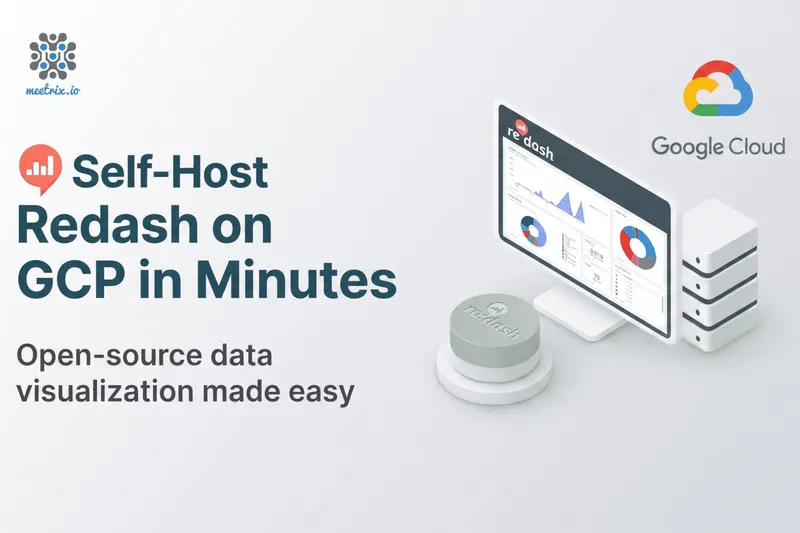
Your Data Team Shouldn't Need a Slack Thread to Answer One Question
Somebody on your team is always the one who "knows the database." Every question - how many signups last week, why revenue dipped on a Tuesday, which feature nobody's touching - ends up in their DMs. Redash exists to get that person out of the loop. Write the query once, turn it into a chart, drop it on a dashboard, and now everyone can just look.
Redash on GCP Marketplace by Meetrix gets you there without the setup tax. Self-hosting Redash properly means wiring up a web server, Postgres, Redis, and a handful of worker processes, then getting SSL right before anyone can log in. We packaged all of that into one Google Cloud listing, so you get a working Redash instance in your own GCP project in minutes. Want to try it? Launch the Meetrix Redash listing on GCP Marketplace.
What is Redash?
Redash is an open-source tool for querying data and turning the results into something people actually want to look at. You connect it to your databases, write SQL (or use the query builder if you'd rather not), and Redash turns the output into charts, tables, or full dashboards that update on a schedule. It's been the go-to option for teams who want a BI layer without paying per-seat for something like Looker or Tableau.
Under the hood it's a handful of pieces working together: a web app for the query editor and dashboards, Postgres to store everything Redash itself needs, Redis for caching and job queues, and Celery workers that actually run your queries against whatever data source you've connected. None of that is your business logic - it's just the machinery that makes "write a query, see a chart" work reliably at any scale.
Why Teams Move Off Spreadsheet-Based Reporting
How Deployment Works
Setting up Redash by hand means provisioning a server, installing Postgres and Redis, configuring Celery workers, and getting a reverse proxy and SSL sorted before you've written a single query. Through the Marketplace, it's four steps:
- Launch from GCP Marketplace Open the Meetrix Redash listing, pick your region and machine type, and deploy. The image arrives with Redash, its Postgres database, Redis, and worker processes already installed and talking to each other.
- Point Your Domain Add an A record pointing your domain at the instance's external IP. Redash needs a real domain for SSL to issue correctly - an IP address on its own isn't enough.
- SSL Issues on Its Own Once DNS resolves, the instance requests and installs a Let's Encrypt certificate automatically. No certbot commands to remember, no renewal cron job to set up yourself.
- Create Your Admin Account and Connect a Data Source Visit your domain, set up the first admin user, and add your first data source connection. From there you're writing queries and building dashboards.
What Meetrix Brings to This Deployment
- The Whole Stack Wired Together - Postgres, Redis, and the Celery workers are already talking to each other on first boot. You're not debugging why a scheduled query silently never runs because a worker process never got started.
- SSL That Renews Without You - Certificates issue and renew on their own. Most people who self-host discover a lapsed certificate the same way - when a dashboard link stops loading in front of someone who needed it.
- Sized Right From the Start - The instance ships with resource settings tuned for actual query workloads, not defaults meant for a demo. Worker counts and connection pools are set so dashboards stay responsive once real people start using them.
- Your Data Never Leaves Your Project - Every query, every result set, every dashboard lives inside your own GCP project. No third party sees your numbers.
- People Who Actually Run This Stack - If a query runner needs a driver you don't have, or workers need tuning under load, you're talking to engineers who deploy Redash regularly, not a ticket queue reading from a script.
Who Is Redash on GCP Right For?
This deployment fits any team that wants shared, queryable dashboards without paying per-seat for a commercial BI tool. It's a strong match if you're:
- A data or analytics team tired of being the only ones who can answer "what does the data say"
- A startup that needs real dashboards but can't justify Looker or Tableau licensing yet
- An engineering team that wants to monitor application metrics without building a custom internal tool
- A company with data spread across several databases that needs one place to query all of it
- A compliance-conscious team that needs query results to stay inside a specific GCP region
- A product or growth team that wants self-serve dashboards instead of filing a request with data engineering
- An agency or consultancy that needs the same reporting setup across multiple client accounts
Redash on GCP by Meetrix vs Alternatives
| Feature | Redash on GCP by Meetrix | Looker | Tableau | Self-Hosted Redash (Manual) |
|---|---|---|---|---|
| Hosting | Your GCP project, fully self-hosted | Google's managed infrastructure | Tableau Cloud or on-prem license | Your GCP VM, set up by you |
| Data Control | Total - queries and results never leave your project | Query results pass through Google's platform | Depends on deployment model chosen | Total, once configured correctly |
| Deployment Time | Minutes via GCP Marketplace | Days to weeks, plus onboarding | Days, plus licensing setup | Hours to a full day |
| SSL & Auth | Automated, issued and renewed on its own | Handled by Google | Handled by Tableau | Manual - easy to misconfigure |
| Pricing Model | GCP compute costs only, no per-seat fees | Per-user licensing, typically enterprise-tier pricing | Per-user licensing, adds up fast for larger teams | GCP compute costs only |
| GDPR / Data Residency | Pick your GCP region, data stays put | Limited region control, Google's terms apply | Depends on hosting tier selected | On you to configure correctly |
| Support | Meetrix engineers, 24/7 | Google support tiers | Tableau support tiers | Community forums, or you fix it yourself |
Resources
Video Guide
How Teams Use This in Production
Ending the Monday Morning Spreadsheet Ritual
The problem
An e-commerce team had one analyst manually rebuilding the same sales and inventory report every Monday, exporting CSVs from three different systems and stitching them together by hand. When she was out, the report simply didn't happen that week.
What we did
We deployed Redash on a Meetrix GCP Marketplace instance, connected it to their Postgres orders database and their inventory system, and rebuilt the weekly report as a scheduled dashboard the whole team could see.
"I used to block out my whole Monday morning for that report. Now it's just there when I open my laptop, and if someone has a follow-up question they can dig in themselves instead of pinging me." Senior Analyst, E-commerce Company, United States
Keeping Query Results Inside a Single EU Region
The challenge
A fintech company needed a BI layer for its transaction data, but its compliance team had ruled out any tool where query results might transit or be cached outside a specific EU region - which ruled out most hosted dashboard tools by default.
Our approach
We deployed Redash inside their GCP project in europe-west3, so every query, cached result, and dashboard stayed on infrastructure they controlled in the required region, and documented the setup for their compliance review.
"Most BI tools couldn't tell us exactly where our data would sit at any given moment. With Redash on our own GCP project, we could point at the region and say that's it, full stop." Head of Data, Fintech Company, Ireland
Replacing a Seat-Based BI Tool the Team Had Outgrown
The problem
A SaaS company was paying per-seat for a commercial dashboard tool, but only three people ever logged in to actually build reports - everyone else just needed to view them, and the licensing model charged the same either way.
What we did
We moved their existing dashboards over to a Meetrix Redash deployment on GCP, mapped their data sources across, and set view-only access for the team members who just needed to read the numbers.
"We were paying full price per seat for people who only ever looked at a dashboard and never wrote a query. Redash let us stop doing that without losing anything the team actually used." VP of Engineering, SaaS Company, Singapore
Frequently Asked Questions
Is this the same as Redash's hosted cloud plan?
No. This runs the open-source Redash stack inside your own GCP project. There's no Redash Cloud account involved, and nobody outside your organization has access to your queries or your data.
What data sources can I connect Redash to?
Most of the common ones - PostgreSQL, MySQL, BigQuery, Redshift, MongoDB, Elasticsearch, Google Sheets, and dozens more through Redash's query runners. If your data lives in a database someone on your team already knows how to query, Redash can probably talk to it.
Do I need to know SQL to use it?
It helps, but it's not required for everyone on the team. Analysts write the queries, then anyone can open the resulting dashboard, filter it, and read it without touching a line of SQL themselves.
Is SSL set up automatically?
Yes. Point a domain at the instance and it requests and installs a Let's Encrypt certificate on its own, then keeps renewing it without you having to remember.
Can I schedule queries to refresh automatically?
Yes. Any query can run on a schedule, so dashboards stay current without someone manually hitting refresh every morning.
What happens when the team outgrows the default setup?
You resize the underlying GCP instance, and for heavier concurrent query loads, Meetrix can help you scale out the worker processes so dashboards don't slow to a crawl during peak hours.
Give Your Team a Dashboard They Don't Have to Ask You For
Stop being the person everyone Slacks for a number. Deploy Redash on Google Cloud in minutes, set up by people who run this stack themselves.
Deploy on GCP Marketplace