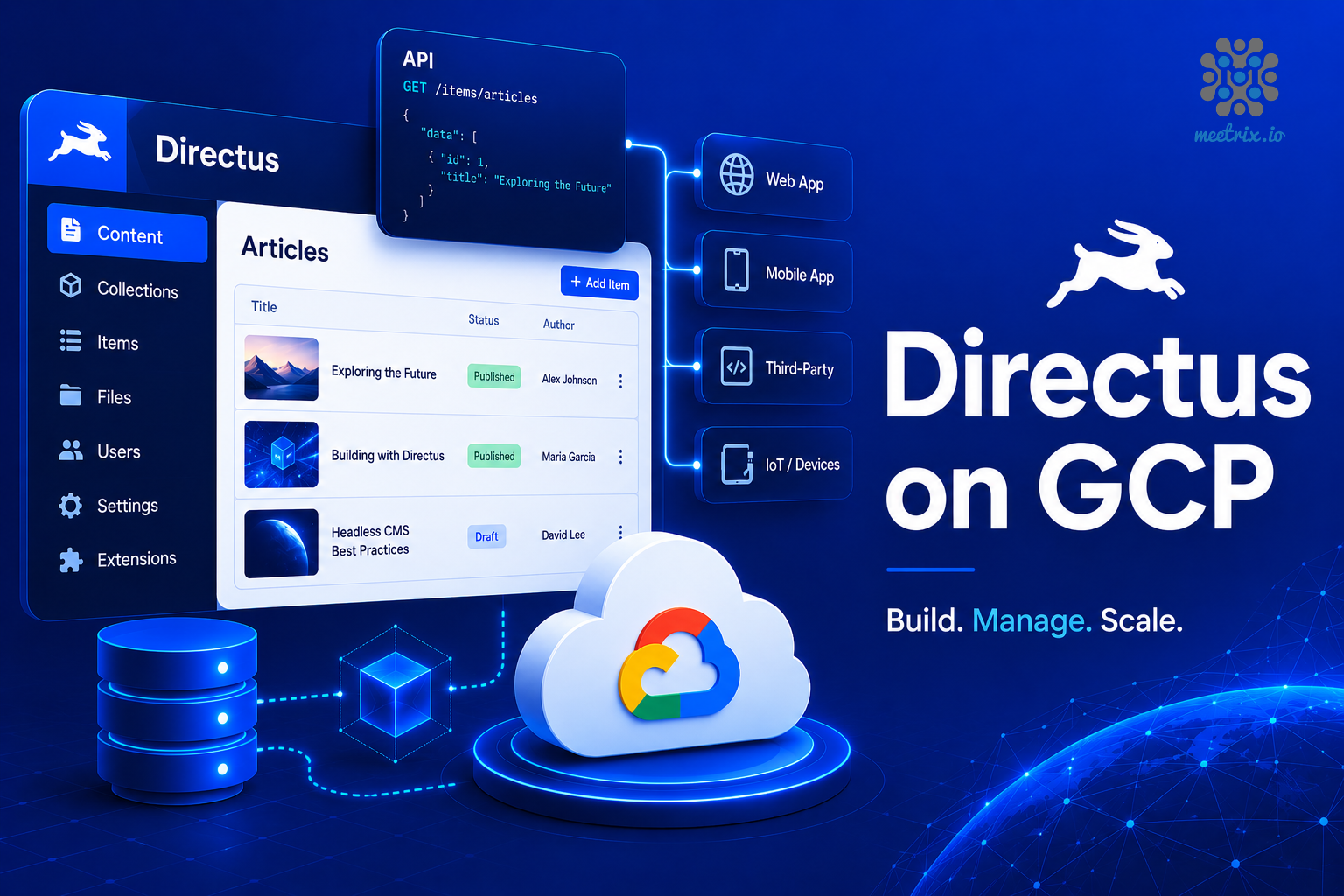
Your Database Already Has the Data. Directus Just Gives It an API.
Most content projects start the same way. Someone needs a backend for a website, an app, or some internal dashboard, and the choices are: build a custom API by hand, or sign up for a hosted CMS that charges per seat, per record, or per API call, and quietly becomes the thing your data lives behind. Neither option feels great once you've done it more than once.
Directus on GCP Marketplace by Meetrix skips both. We packaged Directus, its database, and SSL into one Google Cloud listing, so you get a working REST and GraphQL API on top of your own data in minutes. Want to see it running? Launch the Meetrix Directus listing on GCP Marketplace.
What is Directus?
Directus is an open-source data platform that wraps a REST and GraphQL API, plus an admin app, around a SQL database. Point it at PostgreSQL, MySQL, or a handful of other databases, and it reads your existing schema and exposes it as an API automatically. No defining content types inside a proprietary system first. Your database stays the source of truth, and Directus sits on top of it.
That makes it different from most "headless CMS" products. A typical CMS wants to own your schema and your data. Directus assumes you might already have both, and just needs to wrap an API and a usable interface around what's there. It also ships with asset transformation, field-level permissions, and a flow builder for automations, so it covers more ground than a plain API layer.
What Building an API Layer Usually Costs
How Deployment Works
Standing up Directus yourself means provisioning a server, wiring up Postgres, configuring environment variables, and putting SSL in front of it before the API is even reachable. Through the Marketplace, it's four steps - or follow our Developer Guide for the full walkthrough with screenshots:
- Launch from GCP Marketplace Open the Meetrix Directus listing, pick your region and machine type, and deploy. The instance comes with Directus and its database already connected.
- Point Your Domain Create an A record pointing your domain at the instance's external IP. Directus needs a real domain before SSL can be issued.
- SSL Issues on Its Own Once DNS resolves, a Let's Encrypt certificate is requested and installed automatically. No certbot, no manual renewal.
- Create Your Admin Account Visit your domain and set up the first administrator account. From there you're modeling collections and the API is already live.
What Meetrix Brings to This Deployment
- The Database Is Already Connected - Directus needs a SQL database to run on. The image arrives with one configured and wired in, so you're not debugging environment variables before you've created a single collection.
- SSL That Renews Itself - Certificates issue and renew without you watching a calendar for expiry. Most people who self-host an API layer find this out the hard way once, usually during a launch.
- No Per-Request Billing - You're paying for the GCP instance underneath, not a metered API call count that climbs as your app gets more traffic.
- Your Schema Stays Yours - The database runs inside your own GCP project. Nobody else holds a copy of your content or your API logs.
- People Who Run This Stack Themselves - If you need help with backups, scaling the instance, or setting up a Flow automation, you're talking to engineers who deploy this image regularly, not a generic support form.
Who Is Directus on GCP Right For?
This deployment fits teams that need a real API in front of structured data, without adopting a vendor's proprietary content model. It's a strong fit if you're:
- A development team that wants a REST and GraphQL API generated from a database you already have, instead of writing endpoints by hand
- A company replacing a per-seat hosted CMS to cut recurring costs and stop renting access to your own content
- An agency building the same content backend pattern across multiple client projects
- A product team that needs a backend for a mobile app and a website to share without duplicating logic
- A compliance-conscious team that needs content and API data to stay inside its own infrastructure
- A data team that wants a usable admin interface in front of a database non-technical staff shouldn't query directly
- An engineering lead evaluating headless CMS options who doesn't want to be locked into a vendor's schema format
Directus on GCP by Meetrix vs Alternatives
| Feature | Directus on GCP by Meetrix | Strapi | Contentful | Self-Hosted Directus (Manual) |
|---|---|---|---|---|
| Hosting | Your GCP project, fully self-hosted | Self-hosted or Strapi Cloud | Contentful's cloud, no self-host option | Your GCP VM, set up by you |
| Data Control | Total - your existing database stays the source of truth | Strapi generates and owns the schema | Stored on Contentful's infrastructure | Total, once configured correctly |
| Deployment Time | Minutes via GCP Marketplace | Hours for self-hosted setup, instant for cloud | Instant SaaS signup | Hours, more if SSL or the database trips you up |
| SSL & Auth | Automated, issued and renewed on its own | Manual on self-hosted, handled on Strapi Cloud | Handled by the vendor | Manual - easy to forget renewal |
| Pricing Model | GCP compute costs only, no per-request fee | Free self-hosted, or per-seat on Strapi Cloud | Per-record and per-API-call pricing tiers | GCP compute costs only |
| GDPR / Data Residency | Pick your GCP region, data stays put | Depends on hosting choice | Vendor's data processing terms apply | On you to configure correctly |
| Support | Meetrix engineers, 24/7 | Community forums, or Strapi Cloud support tiers | Vendor support tiers | Community forums, or you fix it yourself |
Resources
How Teams Use This in Production
Replacing a Per-Seat Hosted CMS for a Growing Editorial Team
The problem
A digital publisher was running its website and app off a hosted headless CMS billed per editor seat. As the editorial team grew past a dozen writers, the monthly bill kept climbing, and migrating their existing article schema out looked painful.
What we did
We deployed Directus on a GCP instance, pointed it at their existing PostgreSQL database, and set up field-level permissions so writers and editors had appropriately scoped access to the same content.
"We expected switching CMS platforms to mean rebuilding our content model from zero. Directus just read the database we already had and gave us an API on top of it." Head of Engineering, Digital Publisher, United States
Building an Internal API Without Sending Data Through a Vendor
The problem
A logistics company needed a REST API in front of shipment data for an internal dashboard, but their data handling policy ruled out routing operational data through a third-party SaaS API platform.
What we did
We deployed Directus inside their GCP project in their required region, connected it to their shipment database, and configured role-based permissions for operations and support staff.
"We needed an API, not a new home for our data. Running Directus ourselves meant the data never had to leave in the first place." Platform Lead, Logistics Technology Company, Netherlands
Standardizing the Backend Across Fourteen Client Websites
The problem
A web agency was building a different custom backend for nearly every client site, which meant every handover came with its own undocumented quirks and every new hire had to relearn the stack from scratch.
What we did
We helped them standardize on a Directus instance per client, deployed from the same GCP template, so every project started from a known API and admin setup instead of a one-off build.
"Every client backend used to be its own little snowflake. Now we deploy the same Directus template and adjust the schema, instead of starting from a blank repo." Technical Director, Web Agency, Australia
Frequently Asked Questions
What is Directus used for?
Directus turns an existing SQL database into a REST and GraphQL API, plus a no-code admin app for managing the content in it. Teams use it to power websites, mobile apps, and internal tools off a single backend, without writing API endpoints by hand.
Does Directus require a specific database?
No. Directus connects to PostgreSQL, MySQL, SQLite, MS SQL, and others, and works on top of the schema you already have. It doesn't force you into its own proprietary storage format - your data stays in a standard relational database the whole time.
Is Directus a headless CMS or a backend framework?
Both, depending on how you use it. Out of the box it behaves like a headless CMS, with content modeling and an admin app. But because it generates a full REST and GraphQL API automatically, plenty of teams use it as the backend for an app that has nothing to do with content at all.
Can I self-host Directus and still get support?
Yes, that's exactly what this GCP Marketplace listing is for. You get the self-hosted version running on your own infrastructure, with Meetrix handling the server setup and standing by if something needs troubleshooting.
How is Directus different from Strapi?
Both are open-source and self-hostable, but they start from opposite ends. Strapi generates its own database schema from content types you define inside Strapi. Directus does the reverse - it reads whatever schema your database already has and builds the API and admin UI around it, which matters if you've already got a database you don't want to rebuild.
Does Directus support role-based permissions?
Yes, down to the field level. You can restrict which roles see or edit specific fields, not just entire collections, which matters once more than one team is working off the same instance.
Turn Your Database Into an API, Not a Vendor Dependency
Stop paying per seat or per request for access to your own content. Deploy Directus on Google Cloud in minutes, set up by people who run this stack themselves.
Deploy on GCP Marketplace